Your Kids Spend It Before They Even Have It —
Here's How to Fix That
How to set up an allowance system that actually teaches real money skills.
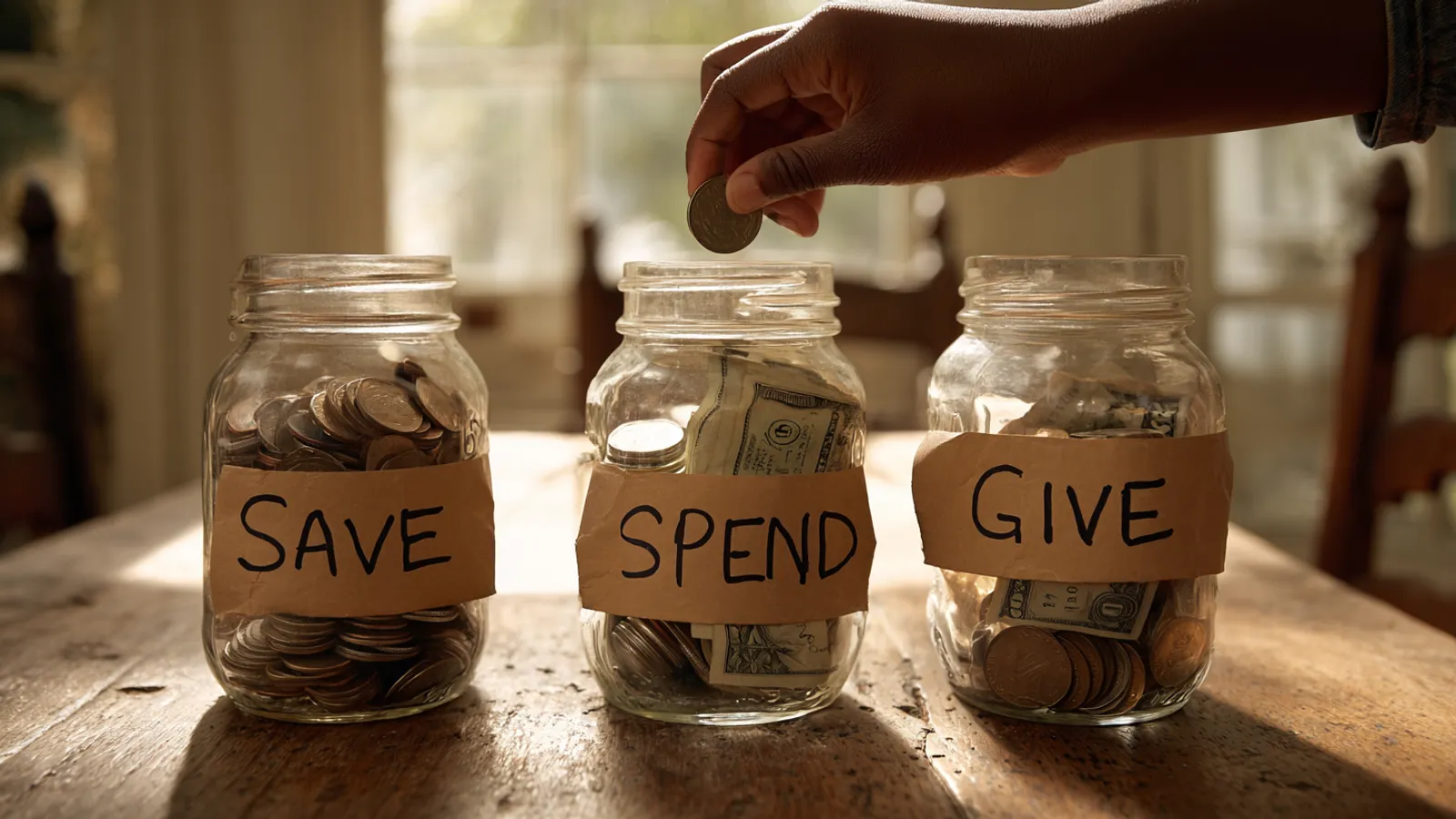
The fix isn't a lecture about money — it's a system that makes earning and spending feel real. Separate unpaid family chores from paid jobs, cap what kids can earn each week, and split every dollar into Spend, Save, and Give, with savings tied to a goal big enough to require patience. A parent match on long-term savings turns the lesson into a decision they actually feel. Here's how we built it across four kids.
Here's something I had to figure out the hard way: kids don't spend money the moment they get it because they're irresponsible. They spend it because nobody ever gave them a reason not to.
No goal. No reason to wait. So why would they?
That was us. My son would receive money and within a few days it was gone — spent on digital items for a video game, things that didn't exist an hour after he bought them. I'd already talked to him about saving. About value. About what money is actually for. He looked at me one day and said, "Dad, it's my money."
He wasn't wrong. And that's when I realized the problem wasn't that he was spending. It was that he had nothing worth saving for — nothing big enough, nothing real enough, nothing that made "waiting" feel worth it.
That's what this post is about: how we built a system in our house, across four kids at very different ages, that finally started to change that. I'm not saying I've figured it all out. But after almost a year, I'm seeing real change. And I want to share what's working.
Why "just teaching them about money" isn't enough
Most parents know they're supposed to teach their kids about money. The problem is that information alone doesn't change behavior — especially in kids.
You can explain compound interest to a 10-year-old and they'll nod and forget it by dinner. What actually changes behavior is experience — specifically, the experience of working for money, choosing what to do with it, and living with the results of that choice.
Ron Lieber, in The Opposite of Spoiled, makes the point that kids need to hear "we're not going to spend money on that" — not as a punishment, but as a complete sentence. They need to understand that money is finite, that it has to be prioritized, and that every purchase is a trade-off. That lesson only really lands when it's their own money at stake.
So the system has to do two things: make earning feel real, and make spending feel like a real decision.
The foundation: not everything gets paid
The first thing we had to get right was the difference between chores and jobs. (I go deeper on this split — and how it ended the daily chore argument in our house — in my post on getting kids to do chores without nagging.)
In our house, some things just come with living here. Making your bed, keeping your room clean, helping set the table — those aren't paid. Those are what you do because you're part of a family. We don't pay our kids to be members of the household.
But then there are jobs — work that adds real value to the family, or saves us as parents meaningful time. Washing the car. Deep cleaning the bathroom. Mowing the lawn. Organizing the garage. Those get paid.
Each job has a clear expectation attached to it, based on the child's age and ability. If the job is done to that standard, they get paid. If it's not, we send them back to finish it. No argument, no negotiation. The expectation doesn't move.
When expectations are clear and consistent, the parental frustration almost disappears. They don't argue because they already know the rules. And over time — it doesn't happen overnight — they start to just do it.
The ceiling for our kids is about $10 per week if they complete everything. But they have to earn every dollar.
The split: Spend, Save, Give
Once they're earning, the next question is what to do with it. The three-bucket system — Spend, Save, Give — is well-established for a reason. It works. But the way you introduce it matters.
Spend: This is theirs, no strings attached. Let them make choices you disagree with. The digital purchase my son made that disappeared an hour later? That was one of the best financial lessons he ever got — and I didn't have to say a single word. The disappointment taught it.
Save: This only works if it's attached to a goal. A vague instruction to "save" is meaningless to a kid. But saving for a specific thing — something big enough that it requires patience — that's where the behavior shift happens.
My oldest wants a gaming computer. When he started saving for it, he did the math. He realized that what he earns at home wouldn't get him there fast enough. So he started thinking about how to earn more — offering to do yard work for neighbors, looking for other ways to make money outside our house. That's entrepreneurial thinking. I didn't teach him that directly. The goal taught him.
Give: In our house, this is 10% of whatever they earn — non-negotiable, but also not a punishment. We keep the conversation low pressure, but the habit is consistent. Even a dollar set aside for something outside themselves starts building a different relationship with money — one where it's a tool for impact, not just consumption.
The incentive that actually works: parent-matched investing
Here's where I've seen the hardest shift, but also the most important one.
We tell our kids: whatever you want to set aside long-term — we'll match it dollar for dollar. It's our version of a 401(k) match, at a level a child can understand.
When we first started, I made the mistake of letting them withdraw from that account whenever they wanted. I quickly realized that defeated the entire purpose. So we made a new rule, and it doesn't move: once you invest it, it stays there until you turn 18. And if you withdraw early, our match comes back to us.
That rule created a real decision. And real decisions create real lessons.
My middle son — he's 10 now, was 9 at the time — decided to withdraw his investment savings to buy a 3D printer. He had a plan: print models and sell them. He forfeited our match when he withdrew, which he accepted. And the plan wasn't bad — he did sell models for a while, made some money, and learned what it felt like to run a small operation.
But as his dad, I quietly tracked what he'd made versus what the printer cost. I didn't say anything right away. I let him run it. And eventually, through our own conversations, he started to realize the math wasn't working — that the printer had cost more than he'd ever made back from it.
That lesson — the real cost of a purchase, the difference between revenue and profit, the risk of spending money you can't recover — I couldn't have taught him that in a conversation. He had to live it.
This has been a tough sell overall. For a kid, five or ten years sounds like another lifetime. Every time I hand them money I say the same thing: "Five dollars today can be worth a lot more if you leave it alone." It doesn't always land immediately. But I keep saying it.
How to Turn $100 into $1,000,000, written specifically for kids 10 and up, makes this concept feel achievable in a way a parent's voice sometimes can't. I recommend handing it directly to your older child and letting the book carry the message.
Different ages, different motivators
One thing I've learned with four kids is that the same system doesn't work the same way across all ages. The structure can be the same, but the motivators have to change.
Younger kids (ages 4–8): Connection is the currency. A one-on-one date with dad, getting to choose the movie, staying up a little later — these carry more weight than the money itself. At this age, the money system is about teaching the mechanics: earn, split, spend wisely. The emotional reward is time with you.
Older kids (ages 9–15): Money and autonomy start to matter more. Friends become the priority. Screen time, freedom, the ability to afford the things their friends have — those are the real motivators. Tie the system to real goals and real consequences, and it lands.
Your job is to build a consistent structure, then adapt the incentives to the child in front of you. There is no single system that fits every kid. But clear, consistent expectations — those work across all of them.
The habit I borrowed from my dad (that I'm trying to pass on)
When I was a teenager, my dad used to pay me to read. Not children's books — real books. Rich Dad Poor Dad by Robert Kiyosaki. The Richest Man in Babylon by George Clason. Think and Grow Rich by Napoleon Hill. The Millionaire Next Door by Stanley and Danko. Secrets of the Millionaire Mind by T. Harv Eker. How to Win Friends and Influence People by Carnegie. Books that rewired how I thought about money, work, and what a life could look like.
But here's the part that made it work: he didn't just hand me any book and pay me to finish it. He curated a list — a set of books he pre-approved — and I could choose which one I wanted to read from that list. My choice, within his boundaries. And when I finished, I had to deliver a full written summary.
That detail matters more than it sounds. It connected directly to the same principle behind everything else in this post — you get paid when you add value. My dad hadn't read all of those books. My summary was genuinely useful to him. I wasn't being paid to consume something; I was being paid to produce something. To learn it well enough to teach it back. That's a completely different experience, and a much harder one to fake.
Those books shaped how I think about money to this day. I read those things at 15, 16, 17 — and they landed in a way that no dinner table conversation ever could, because I had to sit with them long enough to explain them.
I'm doing the same with my kids now. We have a list of pre-approved books they can get paid to read. They decide which one they want to tackle — but the book has to come from the list, and the summary is required. My kids haven't jumped at it yet. But the offer stays on the table. And when they're ready, the books will be there — and so will the conversation.
The real goal: freedom
I want to be honest about why I care so much about this.
I hold a Master's in Finance. I understand how money works at a technical level. And still — I'm not where I want to be yet. I have a job I genuinely enjoy. It's flexible, the people are good, and I'm grateful for it. But it still requires more of my time than I'd like to give. There are summers I'd love to take mostly off — to be with my kids, to travel as a family, to be fully present during a season of their lives that won't come back. That's not a reality for us right now.
I'm building toward it. But I share this because I want to be clear: I'm not writing this from the other side. I'm writing it from the middle, as a dad who is actively trying to build something different for his kids — and for himself.
Money, managed well, doesn't buy things. It buys options. It buys time. It buys the ability to say no to things that don't align with your values, and yes to the things that do.
I don't want my kids to be stuck somewhere just to pay the bills. I don't want them making life decisions based on what keeps the lights on instead of what actually matters. That kind of financial trap is real — and I want them to understand early enough to have more choices than most people ever get.
That's the conversation underneath all of this. Not "save your money." But: money, used wisely, can give you a life built around what matters.
What we use to keep it running
One of the reasons systems like this break down is the overhead. Tracking who did what, who got paid how much, what's been approved — it adds up fast. After struggling to keep it consistent manually, I built GrowTide™ to handle the tracking so our family can focus on the conversations that actually matter, not the spreadsheet behind them.
But the app is just a tool. The real work is the system you build at home — the expectations, the consistency, the conversations at the dinner table about what money is actually for. (If you haven't read it yet, my post on the chores-vs-jobs system is the foundation everything in this post sits on.)
That part no app can do for you. And it's worth every awkward conversation to get it right.
If you're comparing chore and allowance apps, I wrote a full comparison of the 9 best chore apps for kids in 2026, including GrowTide and the eight competitors I looked at while building it.
Books worth reading with (or handing to) your kids
For parents:
- The Opposite of Spoiled by Ron Lieber — the best book I've found for parents on raising kids who understand money without entitlement. His core argument: talk about money openly, early, and often.
- Make Your Kid a Money Genius (Even If You're Not) by Beth Kobliner — broken down by age, from toddlers to young adults. If you have kids at different stages like we do, this one earns its place.
For younger kids (ages 4–8):
- Alexander, Who Used to Be Rich Last Sunday by Judith Viorst — a classic about a boy who watches his money disappear one small decision at a time. Kids this age see themselves in it immediately.
- The Berenstain Bears' Trouble with Money by Stan and Jan Berenstain — introduces earning, saving, and the difference between wants and needs in a way young kids genuinely absorb.
- A Chair for My Mother by Vera B. Williams — a beautiful story about saving toward a meaningful goal. Great for talking about why we save and what it feels like to finally get there.
For older kids and teens (and honestly, for you too):
- Rich Dad Poor Dad for Teens by Robert Kiyosaki — hand this to your 12+ year old. The central idea — that the goal isn't a good job but financial intelligence — is worth the conversation it starts.
- The Richest Man in Babylon by George Clason — short, timeless, and written in stories. Easier for teens to absorb than most finance books. The principles haven't changed in a hundred years.
- Think and Grow Rich by Napoleon Hill — best for older teens who are starting to think about their future seriously. Less about money, more about the mindset that builds it.
- How to Turn $100 into $1,000,000 by James McKenna and Jeannine Glista — written specifically for kids 10 and up. It makes saving and investing feel like something they can actually do. The math is real. The motivation is real.
If you take one thing from this list: consider paying your teen to read one of these — with the condition that they deliver a full summary of what they learned. Not a trick. A system. The same one that shaped how I think about money today.
Vince is a dad of four, holds a Master's in Finance, and is the founder of GrowTide — a family chore and rewards app built by a parent who needed it to actually work.
This post is one parent's experience, not professional parenting, medical, or psychological advice. Every kid is different, and if what you're dealing with is bigger than a chore system can hold, a family therapist or your pediatrician is a better starting point than a blog.
Frequently asked questions
How much allowance should I give my kids per week?
There's no universal number, but a common starting reference is roughly a dollar per year of age. In our house the ceiling is about ten dollars per week for completing everything. What matters more than the amount is consistency and the earning structure — every dollar should be tied to jobs completed to standard, not just handed over. Kids need to experience the direct link between effort and income for the lesson to stick.
What is the Save, Spend, Give allowance system?
It's a three-bucket approach where every dollar earned gets split into three parts. Spend is theirs for immediate use — this is where real money lessons happen through mistakes. Save gets tied to a specific goal, not a vague instruction, so there's a real reason to delay gratification. Give is typically ten percent set aside for something outside themselves. The split teaches that money is a tool with multiple purposes, not just consumption.
Should I pay my kids for chores or just give a set allowance?
Separate the two. Some tasks are just part of being in a family — those aren't paid. But actual jobs that add value to the household (washing the car, deep cleaning, mowing the lawn) should be paid based on difficulty. This teaches cause-and-effect: money doesn't appear weekly regardless of effort. Kids learn that work has value, and they start seeking out more jobs when they want to earn more — the foundation of entrepreneurial thinking.
How do I teach my kids to save money?
Saving only works when it's tied to a specific goal big enough to require patience. A vague "save for the future" means nothing to a ten-year-old. But saving for a specific item — a gaming computer, a bike, a trip — creates real decision-making. Consider matching their long-term savings dollar-for-dollar, with a rule that withdrawing early forfeits the match. That rule turns every spending decision into a real trade-off they feel.
At what age should kids start getting an allowance?
Around five or six is when kids can grasp the basic mechanics of earn, split, and spend. At younger ages (four to eight), connection matters more than money itself, so pair a small allowance with experiences like one-on-one time. By nine to fifteen, money and autonomy become real motivators — screens, friends, freedom. The mechanics stay consistent across ages; the motivators change. Match the system to what your kid actually cares about at their stage.
Like this? Get the next one in your inbox.
No-fluff parenting tips on chores, allowance, and screen time — from a dad of four. New posts only, no spam.
You're subscribed!
We'll email you whenever a new post goes up.
By subscribing you agree to our Privacy Policy. · Also get the app: Google Play · App Store