Average Allowance by Age:
How Much to Give Kids 5 to 18
The scary “$37 a week” headline, the real number for every age, and how to pick the right amount for your family.

How much allowance should you give your kids? Less than the scary headline. The average runs from about $6 a week at age 5 to $8.50 at 10, $15 at 15 and $25 at 18, going by Greenlight's 2025 account data. Till Financial's figures run higher for teens, at $18 to $25 for a 15-year-old. The $37 you may have seen comes from a 2025 Wells Fargo survey that puts every age from 5 to 17 into one number, so it can't tell you what a 10-year-old gets.
| Age | Greenlight average, 2025 | Till range, 2025–26 | $1-per-year rule |
|---|---|---|---|
| 5 | $6.18 | n/a | $5 |
| 6 | $6.44 | n/a | $6 |
| 7 | $6.79 | n/a | $7 |
| 8 | $7.22 | n/a | $8 |
| 9 | $7.86 | n/a | $9 |
| 10 | $8.53 | $7–$10 | $10 |
| 11 | $9.35 | $8–$12 | $11 |
| 12 | $10.37 | $10–$15 | $12 |
| 13 | $11.59 | $12–$18 | $13 |
| 14 | $13.13 | $15–$20 | $14 |
| 15 | $15.26 | $18–$25 | $15 |
| 16 | $17.89 | $20–$35 | $16 |
| 17 | $21.47 | $25–$45 | $17 |
| 18 | $25.01 | $30–$50 | $18 |
What is the average allowance for kids?
It depends on the source: $37 a week in Wells Fargo's 2025 survey, $17 at Till Financial (median $10) and $13.15 at Greenlight. The $37 comes from a survey of 1,587 parents with kids aged 5 to 17. Treat it as a headline, not a target: it covers every age in one number, and the release gives no breakdown by age. Greenlight's figure comes from its 2025 account data for kids 5 to 19, and Till calls its $10 median the more realistic benchmark. In my own house the paid jobs are built around $10. There is a reason the big number sticks. Psychologists call it the anchoring effect, our well-documented tendency to lean on the first figure we hear, which Kahneman and Tversky named decades ago. That is my analogy rather than an allowance study, but it fits: anchor on $37 and $10 feels stingy; anchor on the by-age reality and $10 feels about right for a 10-year-old. The other end of that question, where a number stops being generous and starts doing damage, is answered below in is $37 a week too much allowance?
How much allowance should you give by age?
Start with the table at the top of this page: allowance climbs every year, from about $6 a week at age five to about $25 at eighteen in Greenlight's 2025 figures. Till Financial's ranges sit above Greenlight's average from about 13 on. A common shortcut is the $1-per-year-of-age rule: a 10-year-old gets $10, a 15-year-old $15. It sits a little above Greenlight's average from about 7 to 14, matches it at 15, and falls behind both datasets from 16. It is a fine starting point, not a law. Then adjust two ways: down if your budget is tight, and up if your kid is expected to cover more of their own costs.
What does the table say for your kid?
From the lower of Greenlight's 2025 average and Till Financial's 2025–26 range, to the top of Till's range (Till starts at age 10); US dollars, weekly. A starting point, not a rule.
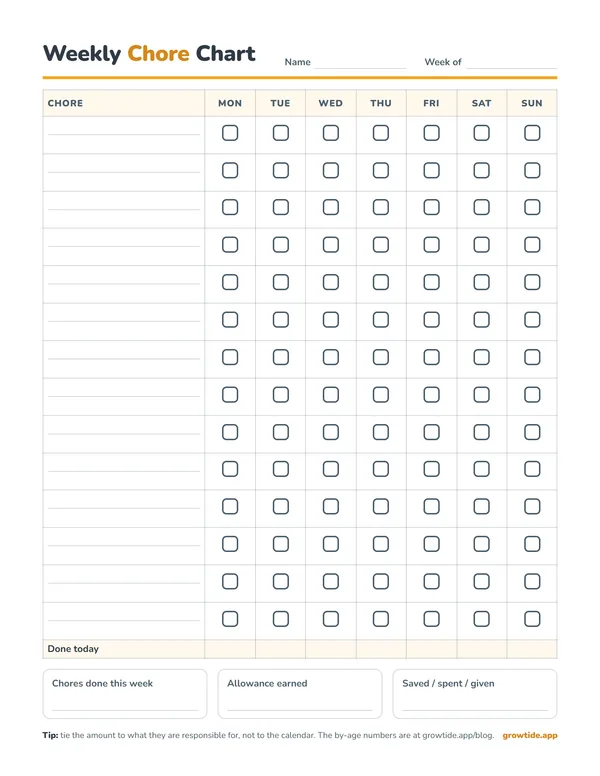
Want the chart on the fridge?
A one-page weekly chore chart you can print: seven days, room for fourteen chores, tick boxes, a line for the week's allowance. Free, no app needed.
Here it is.
Download the chore chart (PDF)
Print it, stick it on the fridge, and when the paper stops keeping up, GrowTide keeps score for you.
We keep your address only to tell you when the chart changes or a new printable comes out, nothing else, unless you tick the box. Privacy Policy.
What is the average allowance for teens?
About $18 a week, going by Greenlight's 2025 average for ages 12 to 19, though that one number hides a wide spread: a 13-year-old averages $11.59 and a 17-year-old $21.47. Till Financial's data reads higher, from $15 to $20 at 14 up to $30 to $50 at 18. The jump comes late. In Greenlight's figures the step from 16 to 18 is $7.12, more than the $5.91 between 8 and 14. A teen's number usually has more to cover by then, like a movie with friends or a subscription. In our house the paid jobs are built around $10 a week per kid, which is below both datasets. My thirteen-year-old can earn that, but he decides to miss some jobs: over the last 12 weeks he actually earned about $7 a week, anywhere from $1 to $12 depending on the rotation and what he skipped. We don't have a lot of optional jobs on top of it. He has never pushed back on it, he just accepted it. He still saved enough to buy his own computer setup, after working out that home pay was too slow and offering yard work to neighbors. If the harder problem is getting a teenager to do the work at all, that one has its own answer.
How much allowance should a 10 to 18 year old get?
About $7 to $10 a week at 10, $10 to $15 at 12, $13 to $20 at 14, $15 to $25 at 15, $18 to $35 at 16, $21 to $45 at 17 and $25 to $50 at 18. Each range runs from the lower of Greenlight's 2025 average and Till Financial's range up to the top of Till's. The high end tends to go with a kid paying for more of their own life. The $1-per-year-of-age rule tracks the data well at 10 and falls behind it from 16.
| Age | Typical weekly range | $1-per-year rule | What to know |
|---|---|---|---|
| 10 | $7–$10 | $10 | Top of the range, where the rule and the data agree; Greenlight's average is $8.53 |
| 11 | $8–$12 | $11 | Greenlight's average is $9.35 |
| 12 | $10–$15 | $12 | Greenlight's average is $10.37 |
| 13 | $12–$18 | $13 | Greenlight's average is $11.59, just under Till's range |
| 14 | $13–$20 | $14 | Greenlight's average is $13.13; Till's range starts at $15 |
| 15 | $15–$25 | $15 | Greenlight's average is $15.26; raise it for what they cover, not for the birthday |
| 16 | $18–$35 | $16 | Greenlight's average is $17.89; the rule now runs below both datasets |
| 17 | $21–$45 | $17 | Greenlight's average is $21.47; the range is wide because Till runs much higher |
| 18 | $25–$50 | $18 | Greenlight's average is $25.01; the Wells Fargo survey stops at 17, these two do not |
Is $37 a week too much allowance?
For most kids, yes. The $37 figure covers every age from 5 to 17 in one number. No age in Greenlight's 2025 table reaches it, even 19 at $30.12, and only Till Financial's ranges for 17 and 18 stretch that far. T. Rowe Price's 2021 Parents, Kids & Money Survey also came in lower, at a mean of $19.30 a week, with 14% of the parents who give an allowance handing over $51 or more. There is no universal cap, but there is a gut check. If your child sits well above their by-age range, spends it within a day, and never has to wait or save for anything, the amount is too much, whatever the number happens to be. Three signs tend to show up together:
- It’s gone in a day, on nothing they can name later. Money that arrives easily gets spent like it arrived easily.
- They never have to wait, save, or choose. If every want is covered before they feel the gap, the allowance is doing their budgeting for them.
- It drifted past what you meant it to cover. If it started as a weekly treat and now funds everything, the number outran its job.
The real cost of overpaying is not your budget; it is that your kid never practices waiting. The classic Stanford marshmallow studies tied a child’s ability to delay gratification to better outcomes later, though newer replications found the effect smaller once a family’s circumstances are accounted for. Take the strong version with a grain of salt. The ordinary version holds in any kitchen: a kid who saves three weeks for something values it differently from a kid who can buy it on a Tuesday.
How do you lower an allowance without a fight?
Out in the open and tied to a reason, the way you would change any house rule, rather than quietly cutting the number and hoping nobody notices. Anchor to the by-age range instead of the headline, and tie the money to a finished job, so a half-finished one pays nothing until it is done. Then say the change out loud: here is the new number, and here is what it is meant to cover. A cut, like a raise, means far more when the kid can see the rule behind it. One thing a cut should never be is a penalty for behavior; taking away allowance as punishment teaches something quite different from lowering a number on purpose.
Should the amount go up as they get older?
Yes, but tie the raise to responsibility, not the calendar. Older kids cover more of their own costs, a movie with friends, a subscription, a bigger lunch, so a larger number genuinely makes sense. The trap is bumping the amount for age alone. A raise nobody earned rewards getting older instead of doing more, and kids read the difference fast. The cleaner move is to let the number rise as what they are responsible for rises, then say that out loud so the raise actually means something. The map for what they can take on at each stage is age-appropriate chores by age. I got the young end wrong myself. I put all the paid jobs on one rotation across my three older boys, and it is too much for my seven-year-old. He struggles with it, and honestly I don't think he cares much about the money. He is still on the rotation, and we now give his brothers a reason to help: extra game time for all of them. And if a younger sibling protests that it is not fair, name the gap and tie it to responsibility instead of pretending the amounts should match. I worked through that exact fight, same chore and different pay, in should older kids get more allowance for the same chore.
How do you decide what's right for your family?
Start from what the money is for, not the size of the average. In our house the paid jobs are built to pay about $10 a week per kid, more or less depending on the week's rotation, and that number has never changed. Every dollar is earned, and a job pays only once it is finished. We run three separate buckets: everyday family chores that are unpaid, a set of rotating paid jobs, and a few extra optional jobs a kid can pick up for more when they want it. Whatever a kid earns gets split into Save, Spend, and Give, and the long-term savings get a parent match that stays locked until they turn eighteen. Anything they want from the grocery store comes out of their own money, and so does anything they don't need. My ten-year-old bought his own monitor, keyboard and mouse, and the boys will chip in to help each other buy things. The dollar amount matters less than what it teaches them about earning and waiting. So pick a number you can fund every single week without resentment, tell your kid exactly what it is meant to cover, and let the buckets do the teaching instead of a lecture. Whether the money should hang off chores in the first place is its own call, and I laid out the split we landed on between unpaid chores and paid jobs.
How do you keep the allowance number honest?
Keep it somewhere other than your head. Most of the work is tracking who earned what this week, what got saved, and what is still owed. I ran ours on a spreadsheet for too long before I built GrowTide to keep track of the earning, saving, and what each kid is owed so the number I picked actually gets followed through. If you want to see how that loop works, here is how it works.
Vince is a dad of four and the founder of GrowTide — a family chore and rewards app built by a parent who needed it to actually work. Download GrowTide
This post is one parent's experience, not professional parenting, financial, or psychological advice. Every family is different, and what's right in your house is a call only you can make.
Frequently asked questions
What is the average weekly allowance for kids?
It depends on the source. A 2025 Wells Fargo survey says $37 a week across ages 5 to 17. Greenlight's 2025 account data says $13.15 for ages 5 to 19, and Till Financial's says a $17 average and a $10 median. For a single age, the by-age table is the better guide: about $6 a week at 5, climbing to about $25 at 18.
How much allowance should a 10-year-old get?
About $7 to $10 a week. Greenlight's 2025 average is $8.53, Till Financial's range is $7 to $10, and the $1-per-year-of-age rule lands at $10. Treat it as a starting point and adjust for your budget and what the child is expected to pay for themselves.
How much allowance should a 15-year-old get?
About $15 to $25 a week. Greenlight's 2025 average is $15.26, which matches the $1-per-year-of-age rule, and Till Financial's range is $18 to $25. Go toward the top if your 15-year-old covers their own costs, like outings with friends.
Is $37 a week too much for a kid?
For most kids, yes. The $37 figure covers every age from 5 to 17 in one number, and no age in Greenlight's 2025 data reaches it; T. Rowe Price's 2021 survey has a mean of $19.30. If your child is well above their by-age range, spends it within a day, and never has to wait or save, the amount is too much whatever the number is.
Should allowance increase as kids get older?
Yes, but tie the increase to added responsibility and expenses, not just age. Older kids who cover more of their own costs reasonably get more, while a raise for age alone rewards getting older instead of doing more.
Should allowance be tied to chores?
It is a personal call. In our house, everyday family chores are unpaid and a separate set of rotating paid jobs earns money once each job is finished, which keeps helping out from feeling like a transaction while kids still get to earn.
Like this? Get the next one in your inbox.
No-fluff parenting tips on chores, allowance, and screen time — from a dad of four. New posts only, no spam.
You're subscribed!
We'll email you whenever a new post goes up.
By subscribing you agree to our Privacy Policy. · Also get the app: Google Play · App Store