How Do You Get Kids to Clean Their Room?
(Name the Piles, Not the Room)
A bedroom is the one job where we hand a kid a goal instead of a task, and then act surprised when they sit down in the middle of it.
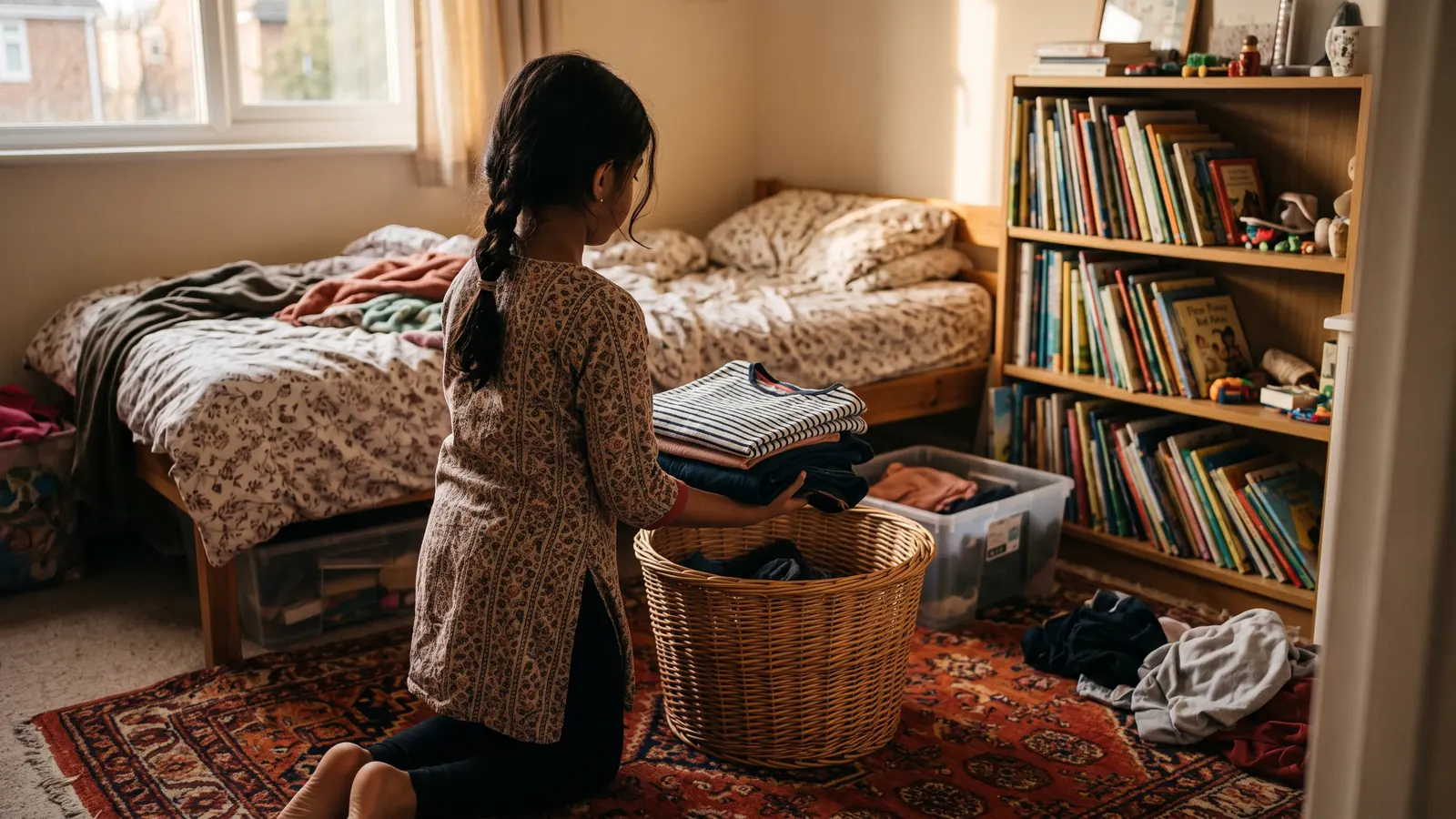
Every chore in our house has a shape except this one. “Take the trash to the curb” is a sentence a seven-year-old can finish. “Clean your room” is a category, and I spent a couple of years quietly annoyed at my kids for not knowing where to start on something I had never actually broken down for them.
The way to get a kid to clean their room is to stop asking for a clean room and start naming the piles it actually contains. Clothes first, then paper, then everything that belongs somewhere else in the house, then the floor. One pile at a time, a couple of minutes a day rather than two hours on a Saturday, and a definition of done you agreed on before they walked in. A bedroom is not one chore. It is a few dozen small decisions stacked up in the only room a kid sleeps in, plays in and keeps everything they own in, which is why “go clean your room” so reliably produces a child sitting on the carpet halfway through a comic with nothing visibly different.
Why won't my kid clean their room?
Because you handed them a goal instead of a task, and a room holds more decisions than a kid can keep in their head at once. Catherine Hansen, an assistant professor with Utah State University Extension, describes the failure almost exactly as it happens at my house: the child walks into a room where toys and dirty clothes are strewn about, finds it overwhelming, does not know where to start, so they sit down amongst the clutter and play, or shove it all under the bed. That is not defiance. It is a task with no entry point. Harvard's Center on the Developing Child defines executive function as the mental processes that let us plan, focus attention, remember instructions and juggle multiple tasks — which is the entire skill set a messy room demands at once, and the one still under construction in a nine-year-old. Naming the piles does the juggling for them. If your child has ADHD, the same idea needs more scaffolding, and I cover it in chores for kids with ADHD, written as short visible steps.
How do you break "clean your room" into steps a kid can follow?
Name three or four categories and work them one at a time, in the same order every time. Hansen's method is to tackle each category individually rather than wandering the room: do the toys, then move to the dirty clothes, and keep going. The specific order matters far less than the fact that there is one, because the order is what removes the decision. Ours runs clothes, paper, things that live elsewhere, floor — and the last one is always quick, because the first three already emptied it.
| Pile | What counts | Full pass |
|---|---|---|
| Clothes | Everything soft goes to the hamper or the drawer. No third option. | 2–4 minutes |
| Paper | School folders, drawings, mail, anything printed. Bin or shelf. | 2–3 minutes |
| Belongs elsewhere | Cups, plates, tools, a brother's things. One trip out of the room. | 2–3 minutes |
| Floor and flat surfaces | Whatever is left, plus the desk and the top of the dresser. | 2–4 minutes |
How much of that a kid owns alone changes with age, and I laid out our splits in age-appropriate chores for kids.
How long should cleaning a bedroom actually take?
One to five minutes on a room that is actually being maintained, and ten to fifteen once it is not. Those are two different jobs, and running them together is why the number in most advice feels wrong to parents. A room that got touched yesterday needs a lap, not a clean: clothes to the hamper, cups to the kitchen, floor clear. Two minutes, no help required. The ten-to-fifteen figure is the full pass — every pile in the table above, done properly, on a room that has drifted for a few days. Hansen's fifteen-minutes-a-day is a ceiling, and she is blunt about why it worked: her kids grumbled at first and became willing participants once they realised she was serious that it would only take fifteen minutes. A short, believable number does real persuasive work; an open-ended one does the opposite. The American Academy of Pediatrics arrives at the same place from another direction in its guidance on age-appropriate chores, telling parents to spell tasks out carefully and introduce one new task at a time because a long list can be overwhelming. The two-hour Saturday excavation is a third thing entirely — not a cleaning session but a symptom of eleven days of neither. If your kid's room needs ninety minutes today, the answer is not ninety minutes. It is ten tomorrow, and two a day after that.
Should kids clean their room every day or once a week?
Both, at different sizes: a short daily reset and one longer weekly pass. The daily reset is the four piles, and it holds best when it hangs off something that already happens rather than a time on the clock. Ours sits in the stretch right after they walk in from school, which is the same anchor the rest of our list runs on. The weekly pass covers what a two-minute reset never reaches: vacuuming, under the bed, sheets. My thirteen-year-old vacuums his own room and needs nothing from me; the ten-year-old is close; the seven-year-old still wants a parent in the doorway for the weekly one, though not for the daily. The concession that bought the most cooperation was letting the older two choose which weekend day the longer pass happens. Not whether. Just when. The anchoring idea is the backbone of our chore routine for the school year.
What do you say when your kid says it is their room?
Concede the part they are right about, and hold the part they are not. A bedroom genuinely is theirs in a way the kitchen is not, and a kid who has worked that out is not being difficult, they are being accurate. So we split it. How it is arranged, what is on the walls, whether the books sit in an order anyone else would recognise — theirs. Food, dishes, laundry someone else has to wash, and anything that would embarrass them if a friend walked in: not negotiable, because those cross the doorway into everyone else's house. What does not work is the word responsibility. I tried it on my oldest at eight, told him his room was his responsibility because he is part of this family, and he agreed and did nothing — not defiance, just an adult word that meant nothing concrete to him. The frame that eventually landed was closer to membership than to duty, which took me years to get right and which I wrote about in why my kids wouldn't do chores without being asked.
What should you do when they say they are done and it is still a mess?
Do not re-clean it, and do not open with a general verdict. Go back to the named piles and check one. “Show me the clothes” is a question with an answer; “this room is still a mess” is an opinion a ten-year-old will happily argue with, and the argument is more fun than the cleaning. The AAP is direct that parents sometimes demand too much or criticise the outcome of a chore, and recommends praising the effort rather than the result — far easier when the standard was concrete before they started. We handle quality the way we handle paid jobs: a half-done bathroom pays nothing until it is finished, and naming the missing part lands as information rather than criticism. The part I have had to sit on is the urge to fix it myself once it is nearly right, because the moment I do, the room is mine again. That flinch is the whole failure mode, and it is what taking ownership of chores actually costs a parent.
If you want the piles to be a checklist your kid can see rather than a list you have to remember, that is roughly what we built GrowTide to do. Each kid gets their own list on their own device, the weekly pass rotates on its own, and screen time unlocks when the list is done. Here is how it works.
Vince is a dad of four and the founder of GrowTide — a family chore and rewards app built by a parent who needed it to actually work. Download GrowTide
This post is one parent's experience, not professional parenting, medical, or psychological advice. Every kid is different, and if what you're dealing with is bigger than a chore system can hold, a family therapist or your pediatrician is a better starting point than a blog.
Frequently asked questions
Why won't my kid clean their room?
Because a room is a goal, not a task. USU Extension describes the exact failure: the child walks in, finds the clutter overwhelming, does not know where to start, and ends up playing or pushing it under the bed. Naming three or four piles gives them an entry point.
How do you break cleaning a room into steps?
Use categories, not areas, and keep the order fixed: clothes, then paper, then anything that belongs elsewhere in the house, then the floor and flat surfaces. The fixed order is what removes the decision-making, and the floor is quick because the first three piles already cleared it.
How long should it take a kid to clean their room?
One to five minutes if the room is genuinely being maintained; ten to fifteen for a full pass once it has drifted. Those are different jobs and most advice conflates them. A two-hour job is neither — that is a backlog. The AAP warns that a long list can be overwhelming and recommends introducing one task at a time, which is the same principle at a smaller scale.
What do I say when my kid says it's their room?
Give them the parts that are genuinely theirs — arrangement, walls, how the books are ordered — and hold the parts that leave the room: food, dishes, and laundry someone else has to wash. Avoid the word responsibility with younger kids; it is an adult word that does not translate into anything they can do.
What if they say they're done and it's still a mess?
Check one named pile rather than delivering a verdict on the room. "Show me the clothes" is answerable; "this is still a mess" invites an argument. And resist finishing it yourself when it is nearly right — the moment you do, the room becomes yours again.
Like this? Get the next one in your inbox.
No-fluff parenting tips on chores, allowance, and screen time — from a dad of four. New posts only, no spam.
You're subscribed!
We'll email you whenever a new post goes up.
By subscribing you agree to our Privacy Policy. · Also get the app: Google Play · App Store