How Do You Get Kids With ADHD to Do Chores?
(Shrink the Job, Shorten the Wait)
A chore asks for exactly the things ADHD makes hard: starting, keeping the order in your head, and finishing. Here is how to build the job around that.
I am not a clinician, and I am not going to pretend to a diagnosis story I do not have. What I do have is one son who has a hard time with chores and a few years of watching how a chore system breaks, and I have put that next to what the published guidance says, because the two meet in a useful place.
To get a child with ADHD to do chores, break each job into short written steps the child can see, stay close (or do the first steps together) until they can run it alone, and make the payoff arrive right after the job instead of at the end of the week. Expect to remind and stay nearby for longer than you would with other kids. That is not a discipline failure on your side or laziness on theirs. The National Institute of Mental Health describes ADHD as difficulty paying attention, keeping on task, or staying organized, and a chore is a task that asks for exactly those three things.
How do you get kids with ADHD to do chores?
Make the job smaller, the steps visible, and the feedback fast. A typical chore fails for a child with ADHD not at the doing but at the starting, the sequencing, or the finishing, so those are the three places to put support. Small steps handle the starting. A list on the fridge or a card in the bathroom handles the sequencing, because the child does not have to hold the order in their head. A same-day payoff handles the finishing.
This is a common situation, not a rare one. The CDC reports that an estimated 7 million U.S. children aged 3 to 17 (11.7%) have a current ADHD diagnosis, based on 2024 data from the National Survey of Children's Health. Most chore advice is written as if that child were the exception. In a lot of households, that child is one of the kids doing the chores.
Why does "clean your room" fall apart for a child with ADHD?
Because it is a goal, not a sequence, and the child has to invent the sequence on the spot. The Child Mind Institute says that breaking chores into steps is especially important for kids with ADHD or learning disorders, and gives the example of swapping "clean your room" for two separate asks: first put the Legos back in the bin, then put the books back on the shelves.
Caroline Mendel, a clinical psychologist quoted in the same article, describes a technique called shaping: start with one small piece of the job and add a piece each week. Week one the child spreads the sheet on the bed; week two, the sheet and the bedspread. The point is that the child finishes something every time, so the job stops being a wall. If you want the room version of this in detail, I wrote out the pile-by-pile order in how to get kids to clean their room, and it works for the same reason: the order removes the decision.
What does a chore broken into steps actually look like?
It looks like a verb and an object per line, short enough to check off without thinking. The test is whether a child who has never seen the job could follow the list with you out of the room. Here is the same set of jobs written the vague way and the stepped way.
| The job | Written vaguely | Written as steps |
|---|---|---|
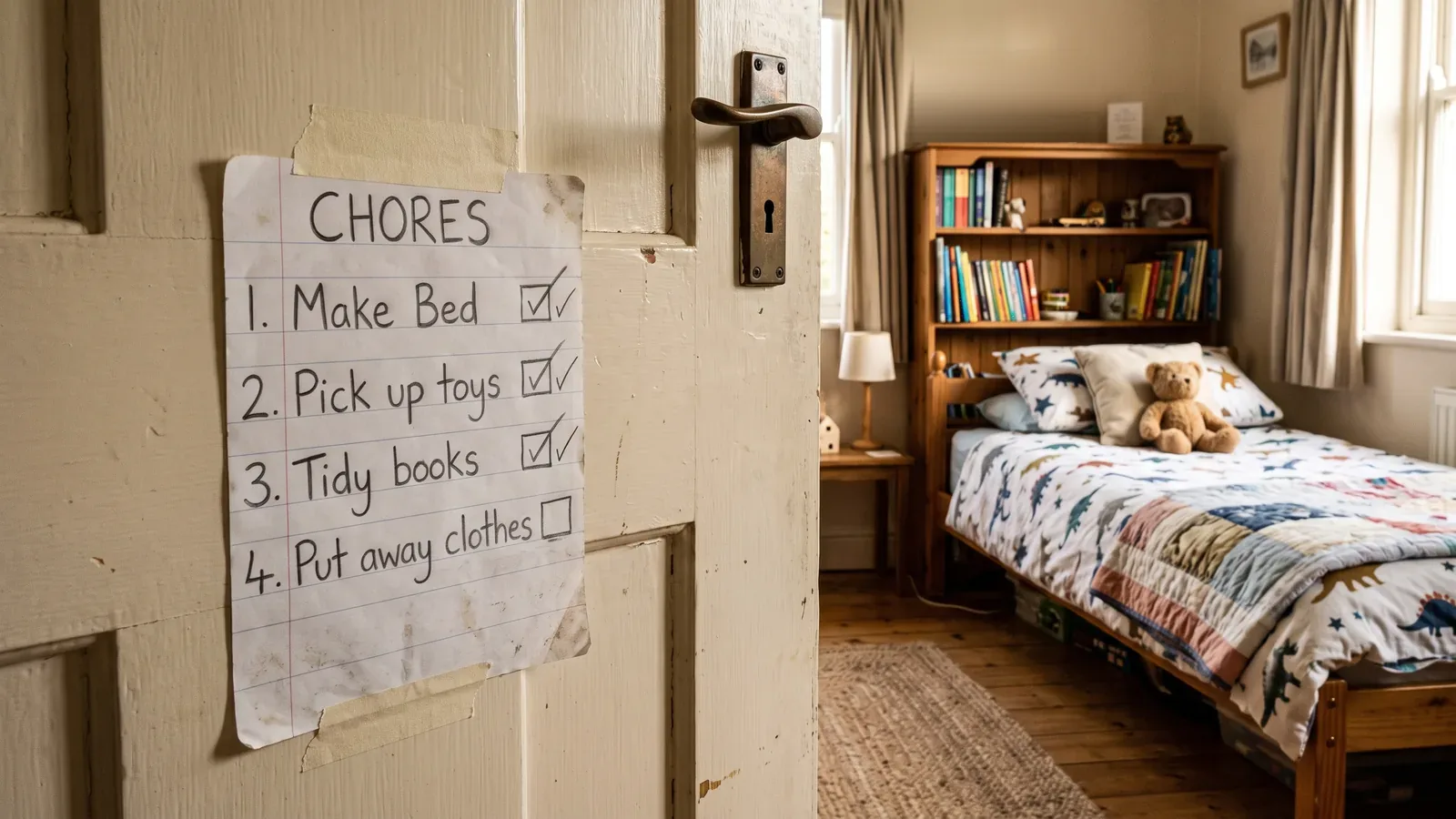
| Bedroom | Clean your room | 1. Clothes in the hamper. 2. Books on the shelf. 3. Toys in the bin. 4. Bed made. |
| Dishwasher | Do the dishes | 1. Open the bottom rack and pull it out. 2. Cups and bowls to their cupboard. 3. Plates to the stack. 4. Silverware to the drawer. 5. Close it. |
| Bathroom sink | Tidy the bathroom | 1. Towels on the hook. 2. Wipe the sink. 3. Wipe the mirror. 4. Trash can to the door. |
| Trash night | Take out the trash | 1. Tie the bag. 2. Put in a new bag. 3. Bin to the curb. 4. Bin lid closed. |
Should you stay in the room while they do it?
For a while, yes, and then less. A parent tip that ADDitude, the ADHD magazine, publishes for teaching a chore is "I do, we do, you do": you do it while they watch, you do it together, then they do it while you watch, and only then does it become theirs. The magazine's chore piece is a collection of parent-contributed tips rather than expert guidance, so treat it as a working method, not a study, but it matches how you would teach any skill.
The catch is that staying close is exactly what a working parent cannot always do. If that is you, the answer is to spend the early weeks teaching the job in person and then move to the model I describe in getting kids to do chores when you work full time: a finished state that someone can check afterward. For a child with ADHD, add a written step list and a phone timer, and expect the "check afterward" stage to arrive later than it would for a sibling.
What kind of reward works when a child has ADHD?
A small one that arrives right away. ADDitude's contributing parents describe things like the photo moved to the "done" side of the chart, a movie that night, and a timer that warns the child before they have to stop what they are doing. A reward promised for Friday is too far from a Tuesday dishwasher to help.
One of my sons has a hard time doing chores, and the pattern is easy to spot. On a day with no games, he likely does not do them, unless a friend comes by wanting to play with him. What has helped is a second gate: to watch TV, he has to have done his chores. That gives him something he wants every day, not only on game days. The friend at the door works for the same reason, because it is a reward that arrives right now.
Pay for the finished job, not for effort. In our house a job pays in full when it is done and nothing when it is not, with no partial pay for a half-done one. When a job comes back unfinished, name the missing part once, in specific terms, which I go into in what to do when your kid does a chore badly. With a child who struggles to finish, the naming matters more, because "you missed the mirror" is something they can act on and "you did it wrong" is not.
How many chores should a child with ADHD have?
Fewer, and shorter, than the age chart says, at least at first. Start with one or two jobs and grow the list once those hold. Then attach each job to a fixed point in the day (before dinner, before screens, when they walk in the door) instead of a clock time, as in the school-year routine, so the cue does the reminding. If you are already mid-fight and reminding all day, how to get kids to do chores without nagging covers replacing yourself as the reminder, and a written list on the fridge is a good first replacement.
When is it more than a chore problem?
When the same difficulty shows up at school, with friends and in most parts of the day, the chore system is not the right tool on its own. Talk to your child's pediatrician. The CDC calls parent training in behavior management the recommended first choice for children under 6 with ADHD, and says parents typically attend 8 to 16 sessions with a therapist to learn strategies built on positive reinforcement, structure and consistent discipline. NIMH lists parent training alongside medication and school interventions among the standard treatments. A chore chart can support that work. It cannot substitute for it.
If you are reading this because chores have become the daily battle in your house, the smallest first move is the one from the table: pick one job, write it as four steps, and stand next to your child for the first week. Here is how GrowTide handles a list like that, with the steps in front of the child and the approval on your phone.
Vince is a dad of four and the founder of GrowTide — a family chore and rewards app built by a parent who needed it to actually work. Download GrowTide
This post is one parent's reading of published guidance, not professional parenting, medical, or psychological advice. Every child is different. If you suspect ADHD, or your child has a diagnosis and you are unsure about treatment, a pediatrician or child psychologist is a better starting point than a blog.
Frequently asked questions
How do you get kids with ADHD to do chores?
Break each job into short written steps the child can see, stay close or do the first steps together until they can run the job alone, and make the payoff arrive right after the job. Start with one or two chores and expect to remind for longer than you would with other kids.
Why does "clean your room" fall apart for a child with ADHD?
It is a goal rather than a sequence, so the child has to invent the order on the spot. The Child Mind Institute says breaking chores into steps is especially important for kids with ADHD. Putting the Legos back in the bin, then the books on the shelves, gives them a first move.
Should you stay in the room while a child with ADHD does chores?
At first, yes. Teach the job in stages: you do it, you do it together, they do it while you watch, then it is theirs. If you work full time, do that teaching in person early and then switch to a written step list plus an after-the-fact check.
What rewards work for kids with ADHD?
Small rewards that arrive right after the job, such as moving a photo to the done side of the chart or a movie that night. A reward promised for the end of the week is too far from a Tuesday chore to help.
When should you see a professional instead of adjusting the chore system?
When the same difficulty shows up at school, with friends and across most of the day. The CDC recommends parent training in behavior management as the first choice for children under 6 with ADHD, typically 8 to 16 sessions with a therapist. A pediatrician can point you to it.
Like this? Get the next one in your inbox.
No-fluff parenting tips on chores, allowance, and screen time — from a dad of four. New posts only, no spam.
You're subscribed!
We'll email you whenever a new post goes up.
By subscribing you agree to our Privacy Policy. · Also get the app: Google Play · App Store