How Do You Get Kids to Do Chores When You Work Full Time?
(Build a System You Can Check, Not Watch)
Almost every piece of chore advice quietly assumes an adult is standing there when the chore happens. Here is the version for parents who are not.
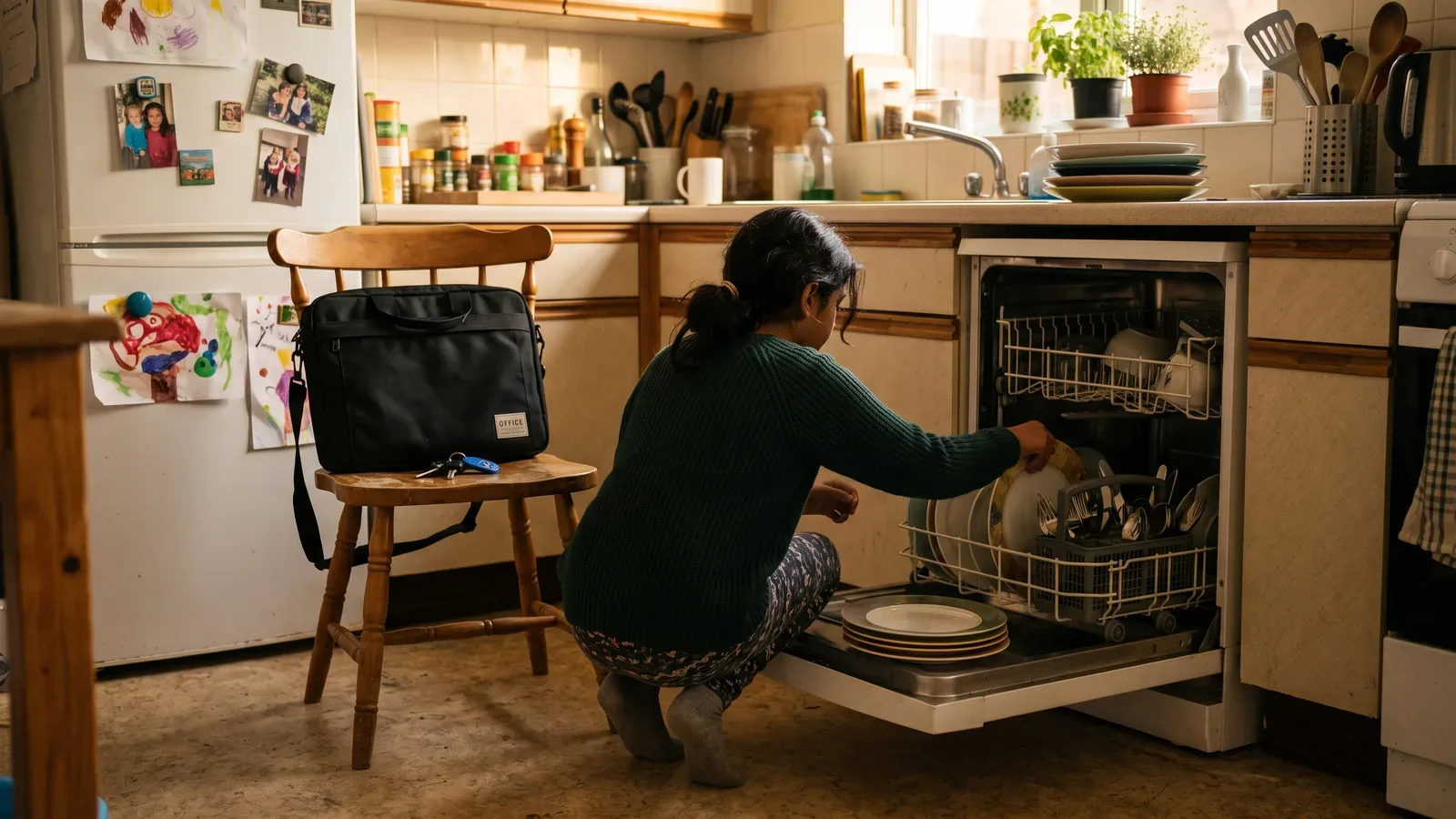
There was a stretch last year when work had me completely buried, and one evening I asked one of my sons whether his chores were done. He said yes. I took his word for it, because going to look would have cost me twenty minutes I did not have. The next morning I saw what he had actually done, which was the easy half.
He had not really lied to me. He had correctly read that nobody was going to check.
If you work full time, stop trying to run chores by supervision and build a system you can check after the fact instead. That means jobs a child can start and finish without an adult in the room, a standard specific enough to be judged from the result rather than from watching the process, and a consequence that arrives on its own while you are still at work. Most chore advice is written for a parent who is home at chore o'clock, which is why it falls apart on contact with a commute. The fix is not more discipline on your part. It is a system that does not need you present to function.
I want to be straight about what I am and am not. I have four kids and I run a business, so I am not home at three in the afternoon and I have never pretended the polished-parent version of this exists. What follows is the working set of rules we landed on after a few years of getting it wrong, plus what the research actually says about households like ours.
How do you get kids to do chores when you work full time?
Design for absence rather than apologising for it. Three things have to be true: the job has to be startable without you, the finished state has to be visible to someone walking in later, and the consequence for skipping it has to land without you enforcing it in the moment. If all three hold, your physical presence stops being load-bearing.
This is not a niche problem. As of 2025, just over half of different-sex couples with children under 18 have two parents working full time, according to Pew Research Center's analysis of Census data. That is up from 46% a decade ago and 31% in 1975. A further 14% of working parents are neither married nor living with a partner. The majority household is now the one almost none of the chore advice is written for.
Why doesn't the usual chore advice work when you work full time?
Because nearly all of it assumes you are in the building. Read the standard guidance closely and the assumption is everywhere. The American Academy of Child and Adolescent Psychiatry's fact sheet on chores and children recommends establishing regular routines, offering the example "clean up before dinner," and giving positive feedback the moment a job is done. All of that is sound. All of it also requires an adult standing near the child at the relevant hour.
The same fact sheet contains the sentence that actually describes the working-parent trap: "It may seem faster to do the chores yourself." When you have ninety minutes between walking in and bedtime, it genuinely is faster. That is the whole problem. The tired arithmetic of a weeknight points at doing it yourself every single time, and if you follow that arithmetic for a year you will have taught your kids that chores are a thing that resolves itself.
Which chores can a kid actually do without an adult in the house?
The ones with a visible finished state and no decision buried in the middle. A job you can verify from the doorway in four seconds is a job that survives you being at work. A job that requires judgement partway through ("is this dry enough?", "where does this go?") stalls the moment nobody is there to answer, and a stalled job looks identical to a refused one by the time you get home.
Here is the sorting rule we use, which has more to do with the shape of the task than the age of the kid.
| Works unsupervised | Needs you there | Why the line falls here |
|---|---|---|
| Unloading the dishwasher | Cooking a meal on the stove | One has a fixed end state anyone can see. The other has heat, timing, and a dozen small decisions |
| Their own laundry, start to finish | Sorting the whole family's laundry | Their own clothes have an obvious owner. Shared laundry needs someone to arbitrate whose is whose |
| Sink, mirror and counter in one bathroom | "Clean the bathroom" | Three named surfaces can be checked. A goal with no parts is where a kid stalls in the doorway |
| Trash and recycling to the curb | Anything with a ladder or a chemical | Safety is the one place where "can they do it alone" is not a question about maturity |
| Vacuuming their own room | A first attempt at any of the above | A job is only unsupervised after you have taught it once with them. The teaching is the part that needs your evening |
That last row is the one I would defend hardest. You do have to spend an evening teaching a job before it can run without you, and there is no route around it. What you are buying with that evening is every subsequent week.
Should you let kids pick when they do their chores?
Yes, the timing, and no, the whether. This is the single change that bought us the most cooperation, and it is close to free. When I stopped specifying the hour and let the older two choose which days they did their rotating jobs, the arguing dropped noticeably. I had been enforcing a clock I was not home to enforce, which meant the rule was really "do it before Dad notices," and that is a rule about me rather than about the work.
Give the deadline as a point in the day rather than a time on it. Before dinner. Before screens. Before bed. Those are events a kid can see coming without a parent narrating them, which is the same principle that keeps a routine standing up through the school year, and it matters more when you are not there to call the time.
What do you do when you get home and the chores aren't done?
Let the result they earned stand, and do not do the job yourself to make the evening shorter. In the case I opened with, I held the line: no game time the following day. There was crying and a slammed door, and it was over in about ten minutes. The cost of holding was one bad evening. The cost of not holding would have been every evening after it.
The harder version is the quiet one, where you do the job yourself because it is 8:40pm and you want to sit down. My wife once spent forty-five minutes vacuuming the stairs for our seven-year-old, then said out loud that she could have done four other things in that time. She was right, and that is the actual price of stepping in: not the vacuuming, the four other things. Judge the work against the standard you taught and let a thin job pay what a thin job pays, which is the case I make for grading a chore instead of redoing it. And when a job simply does not happen, the most useful thing you can do is nothing, which I have written about at length in what actually happens when a kid skips a chore.
Is it bad for kids when both parents work full time?
The evidence on outcomes is not the scary thing here, but parents' own confidence is worth looking at squarely. In Pew's March 2026 survey of 2,242 working parents, about half of those in two-full-time-income households (49%) said their arrangement had a positive impact on their children's well-being. Among dads in families where he worked full time and mom was not employed, 85% said the same.
Read that carefully, because it is a measure of how parents feel about their setup rather than a measure of how the children turned out. A gap that large in self-assessment may be telling you more about guilt than about harm. The same survey found 83% of two-full-time households reported a positive impact on family finances, against 19% of the single-earner ones. My read, and it is a read rather than a finding, is that the chore system is one of the few levers that genuinely closes some of that gap, because it is the thing that keeps a household running when nobody has spare hours.
How long does it take before the system actually works?
Longer than anyone tells you, and the honest number from my house is about a year. My thirteen-year-old now washes his own clothes several times a week without anyone mentioning it. A year ago that was a weekly struggle and mostly did not happen. It shifted roughly six months ago, and I can name three things that were true together: the system kept holding, he had come to feel the job was genuinely his, and he hit an age where what he wore started to matter to him.
That last one is not something a parent can install. What the system did was hold the behaviour in place long enough for his own reason to show up, and then his reason took over. If you are six weeks in and seeing nothing, you are inside the normal shape of this rather than outside it. The thing that eventually transfers is ownership, and stepping back far enough to let it is the discipline I avoided for years.
One practical note on overhead, because it is the failure mode specific to busy parents. For a long time I ran all of this on a spreadsheet I had to update and print every week, and the printing is what killed it. A system a working parent has to maintain by hand is a second job, and it will be the first thing dropped in a bad week. Whatever you use, it has to survive you being too tired to administer it. That is most of why GrowTide exists, and why the kids mark their own jobs done and I approve from my phone on the drive home rather than inspecting anything. Here is how it works.
Vince is a dad of four and the founder of GrowTide — a family chore and rewards app built by a parent who needed it to actually work. Download GrowTide
This post is one parent's experience, not professional parenting, medical, or psychological advice. Every kid is different, and if what you're dealing with is bigger than a chore system can hold, a family therapist or your pediatrician is a better starting point than a blog.
Frequently asked questions
How do you get kids to do chores when you work full time?
Design the system for your absence. Give jobs a child can start and finish without an adult present, define "done" precisely enough that you can check the result rather than watch the process, and set a consequence that lands on its own. Presence stops being the thing holding it together.
Which chores can a kid do without an adult in the house?
Ones with a visible finished state and no judgement call buried in the middle: unloading the dishwasher, their own laundry, a named set of bathroom surfaces, trash to the curb, vacuuming their own room. Anything involving heat, a ladder or a chemical waits for you, and so does the first attempt at any job.
Should you let kids pick when they do their chores?
Let them choose the timing but not whether the job happens. Set the deadline as a point in the day rather than a time on the clock: before dinner, before screens, before bed. A working parent cannot enforce an hour they are not home for, so an hour-based rule really means "before a parent notices."
What do you do when you get home and the chores aren't done?
Let the consequence they earned stand, and resist doing the job yourself to make the evening shorter. Doing it for them buys you one quiet night and costs you the system. Grade the work against the standard you actually taught, and let a half-done job pay what a half-done job pays.
Is it bad for kids when both parents work full time?
In Pew Research Center's March 2026 survey of 2,242 working parents, 49% of those in two-full-time households said the arrangement was positive for their children's well-being, against 85% among dads in single-earner households. That measures how parents feel about their setup rather than how children turn out, and a gap that size may say more about guilt than about harm.
Like this? Get the next one in your inbox.
No-fluff parenting tips on chores, allowance, and screen time — from a dad of four. New posts only, no spam.
You're subscribed!
We'll email you whenever a new post goes up.
By subscribing you agree to our Privacy Policy. · Also get the app: Google Play · App Store