How to Teach a Kid to Clean the Bathroom
(Step by Step, by Age)
“Clean the bathroom” is too big an instruction for most kids. Here is the order we use, what “done” looks like for each part, and the age to start each one.
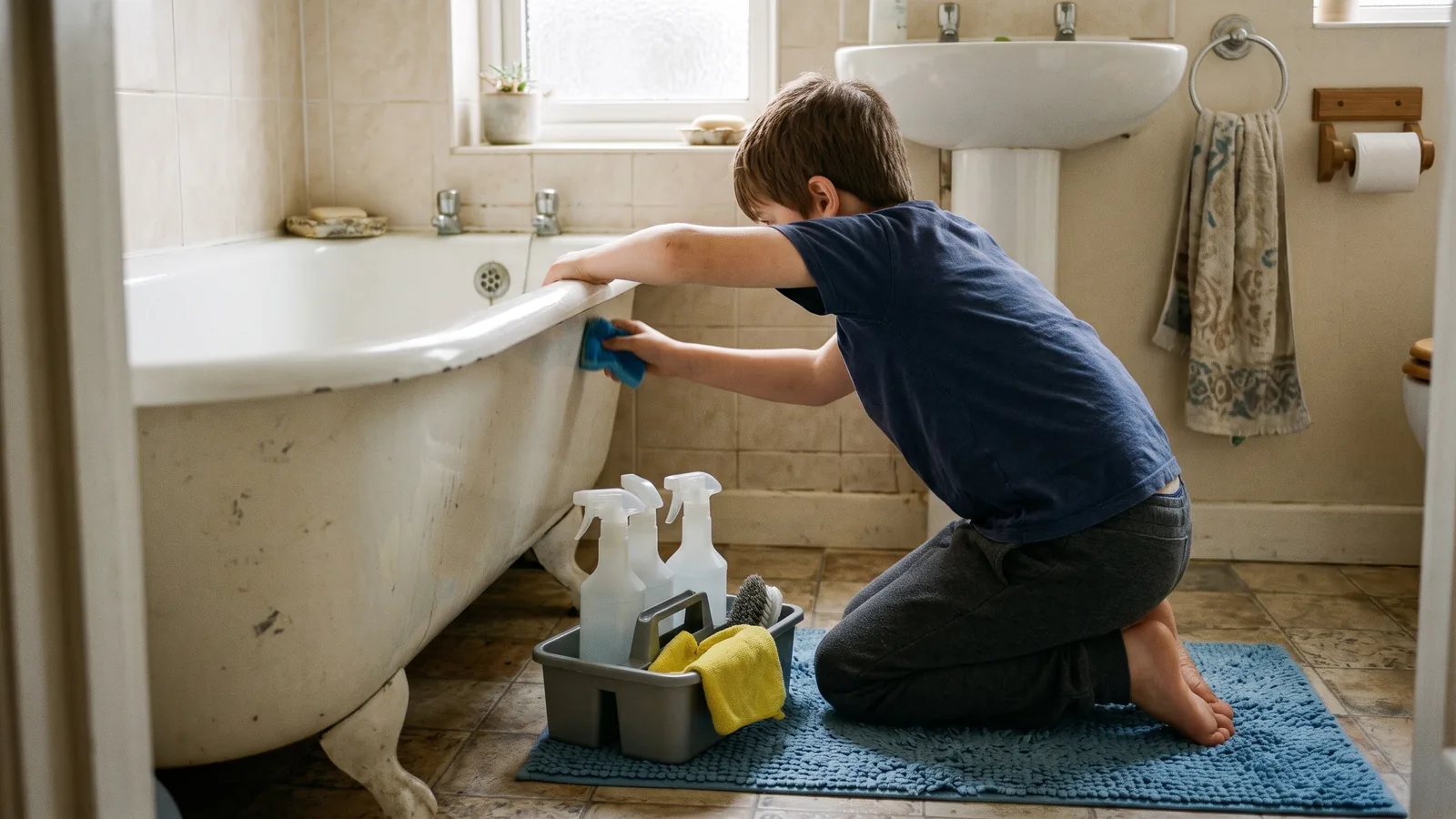
In our house the bathroom is one of the few big chores, and it rotates between our three boys, who are 7, 11 and 13. Whoever’s week it is cleans it at his own level: tidying the counter, wiping marks off the walls, the toilet, and the floor around it. We don’t have the younger two clean the tub yet. The 7-year-old needs a lot more help than his brothers, so I often ask the older two to help him.
Teach a kid to clean the bathroom one part at a time, in the same order every time: mirror, sink and counter, tub or shower, toilet, floor, then trash. Write each part down with what “done” looks like, clean it together until they can name the next step without asking, then let them do it alone and check afterward. Younger kids can do parts of it with help, like the toilet and the floor around it; the tub, and the whole room alone, usually come somewhere between 12 and 14. Give them one mild cleaner in its own bottle, never a mix, and keep drain cleaner out of their reach.
What steps should a kid follow to clean a bathroom?
Six steps, roughly from the cleanest part of the room to the dirtiest, with the trash last: mirror, sink and counter, tub or shower, toilet, floor, trash. Going in that order means the cloth used on the toilet never touches the sink, and anything that drips lands on a part that isn’t done yet. Write the steps down in this order and put the list where the kid can see it while they work.
| Step | What “done” looks like |
|---|---|
| 1. Mirror | No toothpaste spots or streaks when you stand at the sink |
| 2. Sink and counter | Counter cleared, faucet wiped, no hair or toothpaste in the bowl |
| 3. Tub or shower | Walls and tub wiped and rinsed, no soap ring |
| 4. Toilet | Tank, lid, both sides of the seat and the base wiped with a cloth kept only for the toilet; inside scrubbed with the brush |
| 5. Floor | Towels hung, clothes in the hamper, floor wiped, including behind the toilet |
| 6. Trash | Bin emptied, new bag in, toilet paper refilled |
Give the toilet its own cloth in a different color from the sink cloth, and wash it on its own in hot water, or use a paper towel and throw it away. That way a kid can see at a glance which cloth is the toilet one.
What age can a kid clean the bathroom on their own?
Usually somewhere between 12 and 14, once someone has taught them each step. The American Academy of Child and Adolescent Psychiatry lists cleaning bathrooms among the jobs 10- and 11-year-olds can do (AACAP, Facts for Families), and the Children’s Hospital of Philadelphia lists it for ages 10 to 12 (CHOP). Before that, most kids can do parts of the room with help. The ages below are the ones I’d use for each part. They come from our house, not from a medical standard:
- About 5 to 8: tidying the counter, wiping the walls, the toilet and the floor around it, and refilling the toilet paper, with someone working alongside them. They wipe the mirror as high as they can reach.
- About 9 to 11: the same jobs with less help, plus the whole mirror, the sink and the trash.
- About 12 to 14: the tub, and then the whole room alone.
Height matters more than you’d think. Our 7-year-old needs help with the mirror because he can’t reach all of it. He needs a lot of help with the rest of the job too, and of the three, he finds the whole bathroom hardest. When it’s his week, an older brother helps him, and helping counts as part of the older brother’s own chores. The older two take turns being the helper, and they worked out the turns themselves. For the rest of the house, see our list of age-appropriate chores. On a school night there’s usually time for just the sink and mirror, and a full bathroom fits better on a weekend. Our school-year chore routine also keeps bathrooms for the weekend.
As one chore, the whole bathroom is a lot for a young kid. I’ve thought about splitting it into two chores: one for the tub, and one for the rest of the room. We haven’t tried it yet.
How do you teach a kid to clean the bathroom so they can do it alone?
Teach it in three rounds, and make the first one hands-on. The first time, they clean it with you: you work side by side, and they do part of every step while you show them the rest. Then they clean while you watch. Then they clean alone and you check after. Move to the next round when they can tell you the next step without asking. The Children’s Hospital of Philadelphia suggests a similar order for any new chore: show them how it should be done, work on it together, then let them do it alone once they have it (CHOP). We fold the showing into the working together, so a kid’s hands are on the job from the first day. Learning each part can take a few tries. Some kids learn one part a week, starting with the mirror and sink.
A written step list, like the six steps above, does most of the teaching. A kid told to clean the bathroom has to decide what that means. A kid told to wipe the base of the toilet doesn’t have to guess. Without a written list, most kids can’t do a bathroom alone yet, which is why a bathroom with no steps named is on the list of jobs that need a parent there in our post on chores when both parents work full time.
How you hand out the list depends on the kid. When you’re starting out, especially with younger kids, make each step its own chore: one chore for the mirror, one for the toilet, one for the floor. Each one is small, and each one gets finished. Older kids can have the whole bathroom as one chore, with a list of everything that has to be clean before it counts.
In GrowTide, our chore app, you can add a checklist of steps to any chore for free. The ready-made Clean Bathroom chore comes with three steps (clean the sink, clean the toilet, wipe the surfaces), and you can edit, reorder or add steps to match your list. Your kid ticks each step off, and the I Did It! button they tap to say they’re finished is greyed out until every step is ticked (how GrowTide works).
What cleaning products are safe for a kid to use?
A mild spray, a toilet brush and two cloths are enough. In our house we make the spray ourselves, from vinegar and citrus peels (the recipe is in the next section). Keep bleach, drain cleaner and oven cleaner on a high shelf, and don’t let your kid use them. Household cleaning products are the second most common cause of accidental poisoning in US children under 6. In poison-center calls from 2000 to 2015, drain and oven cleaners caused more of the serious injuries than any other type of cleaner (a 2023 study of US poison-center data).
The American Academy of Pediatrics says bleach and ammonia “should never be mixed, because the mixture produces a poisonous gas.” It also says to keep cleaners in their original labeled containers, where children can’t reach them (HealthyChildren.org). Never mix a vinegar spray like ours with bleach, or use it on a surface that was just cleaned with bleach: Poison Control says mixing vinegar with chlorine bleach releases chlorine gas, which is very irritating to the airways, eyes, nose and throat (Poison Control).
So for a kid: one product at a time, each in its own bottle, with the label on. If you make your own, write what’s in it on the bottle. Spray the outside of the toilet and wipe it, then scrub inside the bowl with the brush. Never add a second cleaner to make it stronger. Open the bathroom door or run the fan. Wear gloves for the toilet, and wash hands when the job is done. If you have a toddler, put the cleaning supplies back up high afterward. Children under 6 are the ones most often poisoned by cleaners.
How do you make a homemade bathroom cleaner?
Put orange or lime peels in a jar, cover them with white vinegar, close the lid and leave it for at least two weeks. Then take the peels out and pour the vinegar into a spray bottle. That’s the spray our kids use. Most recipes say two to four weeks is enough. Ours often sits for months, because I only empty the jar when we run out, and the longer it sits, the stronger the citrus smell. Scrape any fruit off the peels before they go in, so nothing in the jar goes moldy. Don’t add water. Water dilutes the vinegar, and watered-down vinegar still cleans but doesn’t kill bacteria well. Ours goes in the bottle straight.
Does it kill germs? Yes, if you use it full strength and give it time. Most white vinegar is about 5% acetic acid. In a 2020 lab test, 5% acetic acid killed more than 99.999% of E. coli, Staph and four other germs on a test surface in five minutes (Zinn and Bockmühl, BMC Microbiology, 2020). That study was paid for by a German company that sells vinegar cleaners. Speed and strength matter: an older test that gave vinegar between 30 seconds and five minutes in a liquid found it killed less than 99.9% of Staph and E. coli, well behind bleach (Rutala and colleagues, 2000). The 2020 authors also found that vinegar watered down to everyday cleaning strength didn’t disinfect.
So for germs, spray it on undiluted, leave it wet for five minutes, then wipe. Five minutes is the time the 2020 test gave it, and it didn’t test anything shorter, so don’t wipe it off sooner. It also works on some viruses: in the same study, full-strength vinegar destroyed a virus with an outer coat, the kind that includes flu, within one minute. Stomach-bug viruses weren’t tested. After a stomach bug, an adult should go over the toilet with a store-bought disinfectant.
A few other homemade cleaners that are cheap and gentle enough for kids to use, from the University of Arkansas extension service:
- Mirror: 3 tablespoons of vinegar in a quart of water, in a spray bottle.
- Sink and tub: baking soda mixed with a little water into a paste. Scrub, then rinse.
- Toilet bowl: flush first if anyone might have used bleach in it. Then pour a quarter cup of baking soda and a cup of vinegar into the bowl. Let it sit for 3 to 30 minutes, then scrub with the brush and flush.
Mix baking soda and vinegar only in the open, like in the toilet bowl, and never in a closed bottle, because the fizz builds up pressure. Keep vinegar off marble, granite and other natural stone, since the acid can dull it.
What do you do when your kid only half-cleans the bathroom?
Send it back for the part that isn’t done, and don’t count the job, or pay for it, until every step is finished. Point at the step on the list, not at the kid: “The floor behind the toilet still needs a wipe.” The list makes it about the step. There’s more on handling this in what to do when your kid does a chore badly.
The Children’s Hospital of Philadelphia also says not to re-wipe the bathroom sink after your kid has cleaned it (CHOP). I don’t always manage that. Before guests come over I go into the guest half-bath and clean it again, even if a kid already did it. I know that takes the job back from the kid. I still do it.
Vince is a dad of four and the founder of GrowTide — a family chore and rewards app built by a parent who needed it to actually work. Download GrowTide
This post is one parent's experience, not professional parenting, medical, or psychological advice. Every kid is different, and if what you're dealing with is bigger than a chore system can hold, a family therapist or your pediatrician is a better starting point than a blog.
Frequently asked questions
What order should you clean a bathroom in?
From the cleanest part to the dirtiest: mirror, sink and counter, tub or shower, toilet, floor, then trash. That way the cloth used on the toilet never touches the sink, and drips land on parts that aren’t done yet.
At what age can a child clean a bathroom alone?
Many kids can clean a whole bathroom alone somewhere between 12 and 14, once they have been taught each step. The American Academy of Child and Adolescent Psychiatry lists bathrooms among the jobs 10- and 11-year-olds can do. Younger kids can do parts of it with help: the counter, the walls, the toilet and the floor around it.
Should kids clean the toilet?
Yes. In our house all three boys clean the toilet, the 7-year-old with help. Give them gloves, a toilet brush and a cloth used only for the toilet.
What cleaner should a kid use to clean the bathroom?
One mild all-purpose spray in a labeled bottle. Ours is homemade: vinegar soaked with orange or lime peels. Never let a kid mix cleaners, and keep bleach, drain cleaner and oven cleaner away from them. Bleach mixed with vinegar gives off chlorine gas, and the American Academy of Pediatrics warns that bleach and ammonia together produce a poisonous gas.
How do you make a homemade vinegar cleaner?
Fill a jar with orange or lime peels, cover them with white vinegar and close it for at least two weeks. Take the peels out and pour the vinegar into a spray bottle without adding water. Full strength, it kills most common bacteria if you leave it wet for about five minutes before wiping, and some viruses, like the flu kind, within about a minute; watered down, it doesn’t disinfect. Never mix it with bleach, or use it right after bleach.
Should you pay a kid for cleaning the bathroom?
If you pay for chores, pay for the bathroom only when every step is done. A half-cleaned bathroom goes back to the kid to finish, and it doesn’t count as done until it’s finished.
Like this? Get the next one in your inbox.
No-fluff parenting tips on chores, allowance, and screen time — from a dad of four. New posts only, no spam.
You're subscribed!
We'll email you whenever a new post goes up.
By subscribing you agree to our Privacy Policy. · Also get the app: Google Play · App Store