How Do You Get a Kid Who Doesn't Care About Consequences to Do Chores?
(Why "I Don't Care" Is Usually About the Consequence)
A shrug usually means the consequence is too far away, too big, or aimed at something the kid stopped wanting. Here is what we change, and when it is more than a chore problem.
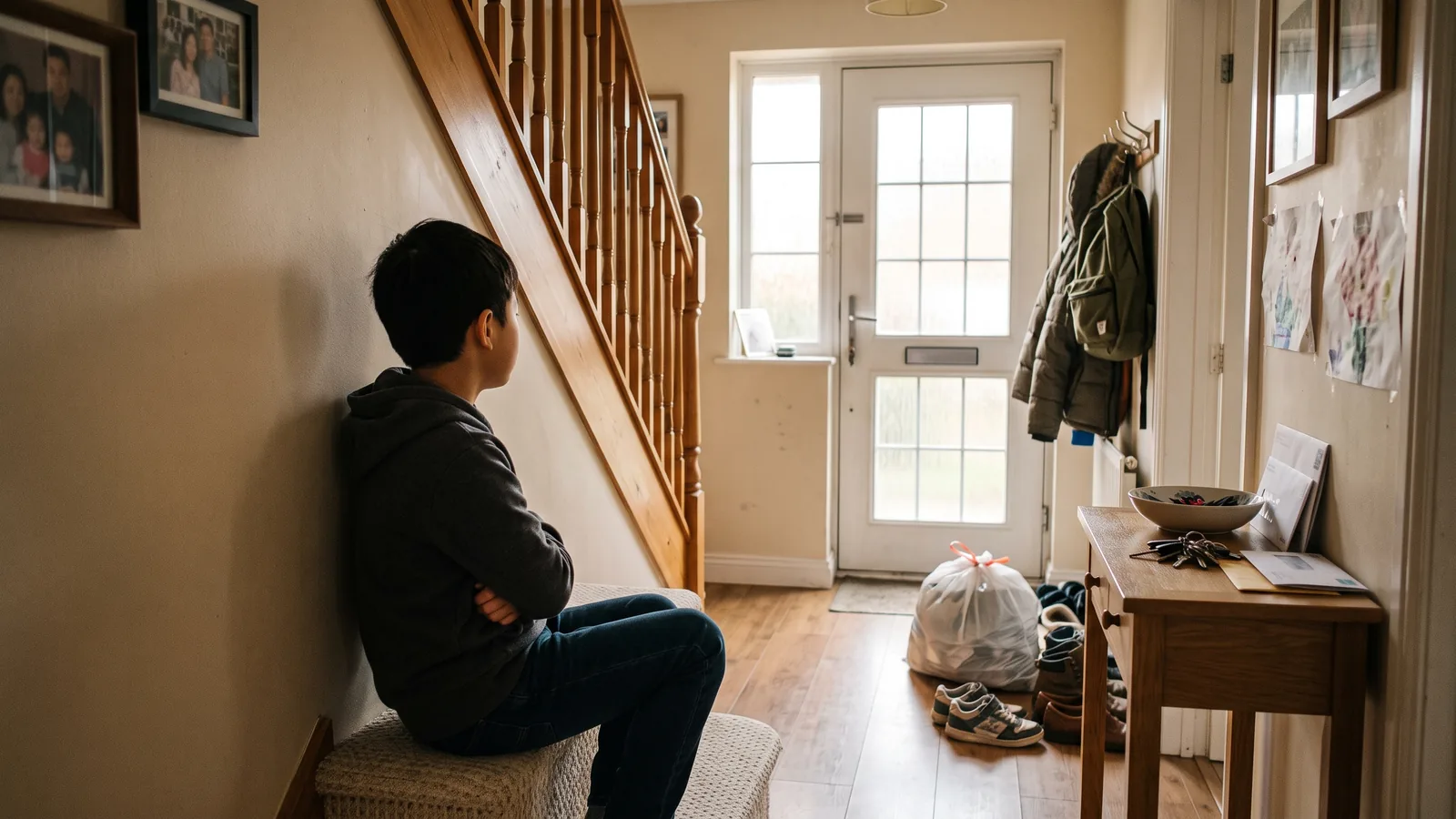
"Fine. Take it. I don't care." If you have heard that while holding a consequence in your hand, you know how fast it ends the conversation. You were counting on the kid caring. Now you are out of leverage and the dishwasher is still full.
I have heard versions of it in my house.
When a kid says they don't care about a consequence, the consequence usually needs fixing: it lands too late, it is too big to recover from, or it takes away something they no longer want. Make it small, same-day and certain, tie it to the skipped job, and still have the job done afterward. If the shrug shows up with every adult and every rule, that is a different problem from chores, and it is covered at the end.
Why does a kid say "I don't care" about a consequence?
Usually the consequence is the problem, and the first culprit is distance. Children weigh the future more lightly than adults do: in a 1994 study, children discounted delayed rewards more steeply than young adults, who in turn discounted more than older adults (Green, Fry & Myerson, Psychological Science). That study used hypothetical money, not chores, so take it as a direction rather than a rule. Still, losing the phone on Saturday for a towel left on the floor on Tuesday is a cost so far away it barely registers.
The second culprit is pride, or something that looks like it. My 13-year-old takes a consequence without a word and does the chore the next day. From the outside, that looks exactly like not caring, and it plainly isn't, because the chore gets done. What the kid does the next day tells you more than the shrug.
Do bigger consequences work better than small ones?
Usually not. What changes behavior is how certain the consequence is, much more than how big it is. The clearest statement of this comes from crime research rather than parenting: the U.S. National Institute of Justice's summary of deterrence research says the certainty of being caught is "a vastly more powerful deterrent than the punishment" (NIJ, Five Things About Deterrence). Adults and prison sentences are a long way from a 10-year-old and a dishwasher, so treat that as a principle rather than a finding about kids. Our own rule is small on purpose: chores come before games, every day, so the kid always knows what happens next.
Size also has a cost that is easy to miss. Take the whole weekend for one skipped job, and Saturday's chores now cost the kid nothing, because there is nothing left to lose. That is the moment "I don't care" stops being a bluff and becomes true.
What consequence actually works for a skipped chore?
One that is small, lands the same day, and follows from the job itself. Small and same-day is my own rule. What the experts add is consistency: the American Academy of Child and Adolescent Psychiatry advises "consequences that can be enforced consistently" (AACAP), and the American Academy of Pediatrics adds one hard limit: never take away something a child truly needs, such as a meal (AAP, HealthyChildren.org).
In our house that means two boring rules. Chores come before games and friends, and paid jobs pay only once they are finished. Screen time runs on its own schedule, an hour of games on Monday, Wednesday, Friday and Saturday, separate from the money. Because the tracks are separate, one bad moment does not blow up the whole week. GrowTide is built around those separate tracks, and here is how GrowTide works if you want to see them.
| Why the shrug | What it sounds like | What to change |
|---|---|---|
| Too far away | "Saturday? Whatever." | Put the chore before the next thing they want today |
| Too big | "You already took everything." | Shrink it so tomorrow starts clean |
| Nothing they want | "There's nothing I want anyway." | Tie the chore to something they use every day |
| Saving face | "Fine. I don't care." | Say nothing, let it land, and check whether the chore gets done tomorrow |
| It lands on you | "You'll just do it anyway." | Stop finishing the job for them |
What if they really don't care about anything you take away?
Then believe them and change what is on the table. Two weeks into our old coin chart, one of my boys told me he didn't care about the coins because there was nothing good in the treasure box. That was a problem with my design: I had built a reward he outgrew in fourteen days, which I wrote up in why chore charts stop working.
Watch what your kid reaches for on a normal free afternoon, and put the chore in front of that. And keep noticing what goes right. Even for children who are defiant across the board, the AACAP's first piece of advice is to "always build on the positives" and praise cooperation when it shows up (AACAP).
Should the chore still get done after the consequence?
Yes. A consequence that replaces the chore turns into a price a kid can choose to pay. If skipping the bathroom costs an hour of games and nothing else, a kid who would rather skip both has just bought his way out of the bathroom. So the job stays on the list until it is done, and the privilege waits behind it. The AAP's version is to be prepared to follow through right away and not to give the privilege back after a few minutes (HealthyChildren.org). How long to let skipped jobs stack is in what happens when your kid skips a chore.
This is where I am worst. The powder room rotates between the boys, and before guests arrive I clean it myself even when it was a kid's job that week. Every time, the consequence lands on me instead of the kid, which is the opposite of what I am asking of them. Money is a separate question, covered in whether to take away allowance as punishment.
When is "I don't care" more than a chore problem?
When it shows up with every adult and every rule, not just at chore time. The American Academy of Child and Adolescent Psychiatry describes oppositional defiant disorder as an ongoing pattern of uncooperative, defiant and hostile behavior frequent enough to stand out next to other kids the same age, and puts it at one to sixteen percent of school-age children and adolescents (AACAP). For a child with those symptoms it recommends a comprehensive evaluation, which also screens for ADHD, anxiety and mood disorders.
A kid who shrugs at a lost hour of games but is fine at school and with friends has a chore problem. A kid at war with every adult in his life needs more than a chore system. "I don't care" and "I forgot again" are different problems too: forgetting needs a system the kid can see, which is what chores for kids with ADHD is about.
My 7-year-old still cries and slams his door when a rule lands on him, and is fine about ten minutes later. The rule holds. The door still slams.
Vince is a dad of four and the founder of GrowTide — a family chore and rewards app built by a parent who needed it to actually work. Download GrowTide
This post is one parent's experience, not professional parenting, medical, or psychological advice. Every kid is different, and if what you're dealing with is bigger than a chore system can hold, a family therapist or your pediatrician is a better starting point than a blog.
Frequently asked questions
Why does my child say "I don't care" when I give a consequence?
Usually because the consequence lands too late, is too big to recover from, or takes away something they no longer want. Sometimes it is pride. A kid who takes the hit quietly and does the chore the next day cares more than the shrug suggests.
Do harsher consequences work better?
Usually not. Research on deterrence finds the certainty of a consequence matters far more than its size, though that work was done on adults and crime. A huge consequence can also backfire: once the whole weekend is gone, there is nothing left to lose.
What consequence works for a skipped chore?
A small one that lands the same day and follows from the job, such as no games or friends until the chore is done. Keep it consistent, and never take away something a child truly needs, such as a meal.
Should a child still do the chore after a consequence?
Yes. If the consequence replaces the chore, it becomes a price the kid can choose to pay. Keep the job on the list until it is done, with the privilege waiting behind it, and do not finish it for them.
When should I worry that my child doesn't care about consequences?
When the defiance shows up with every adult and every rule, not just at chore time. The AACAP describes oppositional defiant disorder as an ongoing pattern that stands out against kids the same age and recommends a full evaluation, which also screens for ADHD, anxiety and mood problems.
Like this? Get the next one in your inbox.
No-fluff parenting tips on chores, allowance, and screen time — from a dad of four. New posts only, no spam.
You're subscribed!
We'll email you whenever a new post goes up.
By subscribing you agree to our Privacy Policy. · Also get the app: Google Play · App Store