Why do chore charts stop working?
(A dad of 4 explains the 11-day pattern)
A dad of 4 explains why most chore charts die around day 12 — and the three-bucket system that finally worked.
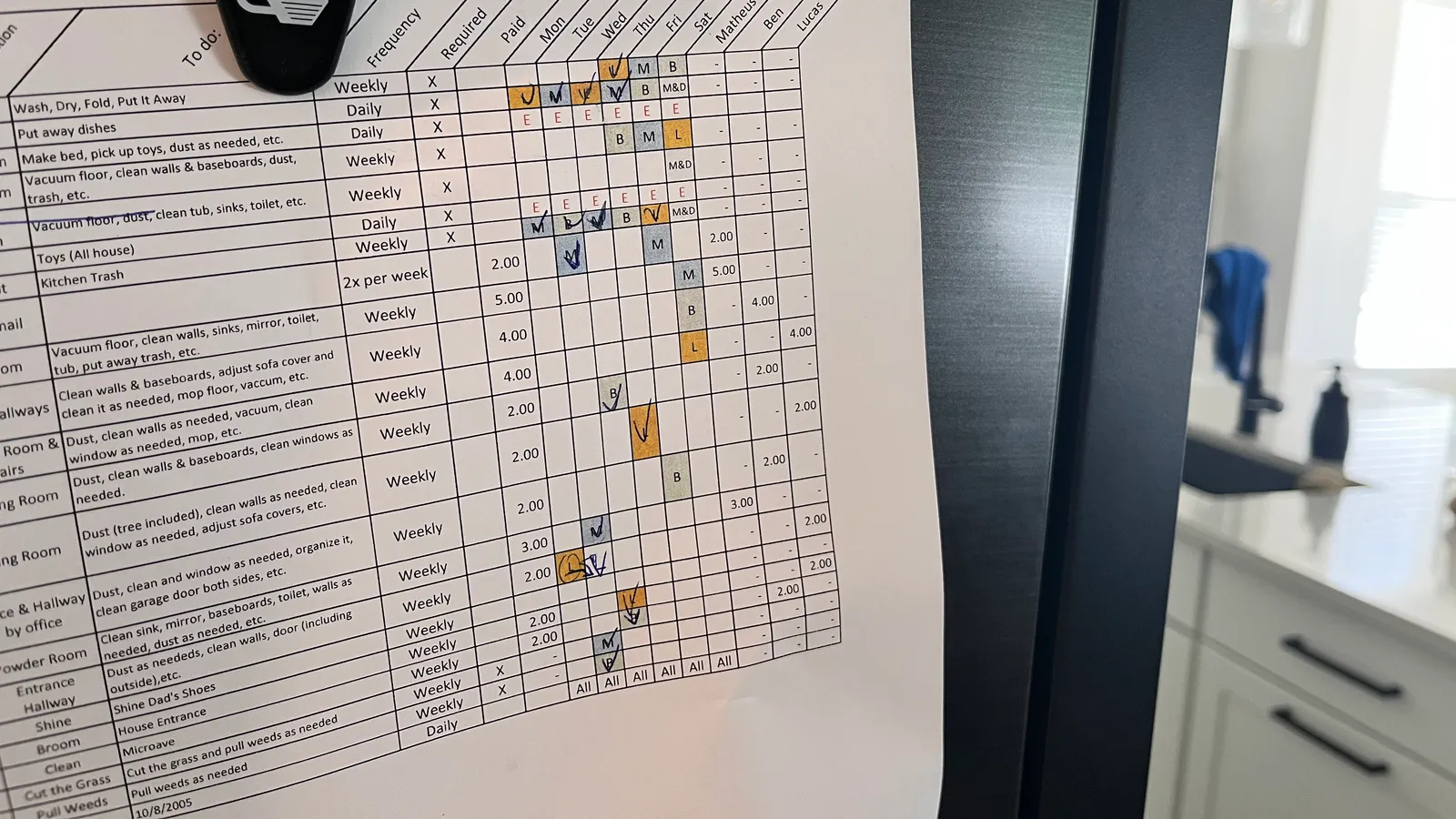
Most chore charts stop working around day 11 because a chart is a scoreboard without a game: once the reward is the only reason to play, motivation collapses the moment the prize goes stale or the adult slips on enforcement. What lasts isn't a better chart but a simpler system — expected chores nobody's paid for, rotating paid jobs, and an optional extra-jobs list — anchored to the kid's day. Here's how ours fell apart, and what finally replaced it.
My 9-year-old looked up from the breakfast table and said, "I don't care about these stupid coins. There's nothing good in the treasure box anyways."
The chart was four A4 papers taped together on the living room wall. My wife made it. Each of our three boys had a column of chores plus a row of "behaviors": be kind, help your brother, be respectful. Each good thing earned a plastic reward coin off Amazon. Twenty coins got you a trip to the treasure box. We had laminated nothing, but we had committed.
And for 11 days, it worked.
Day 12, I was picking up a coin off the floor in the hallway, wondering which kid had dropped it and whether that meant it counted, and the whole system suddenly felt like I was running a small, badly-funded central bank.
Day 14, my 9-year-old called it.
He wasn't wrong.
What we tried before giving up on the chart
We didn't give up right away. We're not quitters. We are, however, tired.
Fix #1: better coins. The plastic ones were getting lost. (Traded. Stolen by the 4-year-old who didn't know what a coin was. Given back by the same 4-year-old, who felt bad about an act he didn't understand.) So we switched to a second paper taped next to the first one with circles the kids could paint in as they earned. More paper. More tape. Same result.
Fix #2: better prizes. My wife kept refilling the treasure box, each refill slightly nicer than the last, because that's the direction these things go. After a while the treasure box budget had its own line in our household expenses. This is not the lesson we were trying to teach.
Fix #3: "let's explain it again." We sat the boys down and re-explained the system with more enthusiasm than the first time. Kids can smell forced enthusiasm. They added it to the list of evidence that the adults in charge were making it up as they went.
Fix #4: no system. Just do your chores because you're a person who lives in this house. Which works until you, the parent, get busy with work and school and a new baby and forget to ask. A chore system that lives in the parent's head dies the first week the parent has an actual week.
None of these were bad ideas. They just all reset the 11-day clock.
The quiet part most advice skips
Every article you've Googled about this says the same three things: make the chart more visual, add better rewards, get your kid's buy-in.
Here's what none of them say out loud:
A chart is a scoreboard. Without a game, no one plays.
The chart tracks the thing. The chart isn't the thing. And when the reward is the only reason to play, the game ends the second the reward gets stale, or the second someone notices they can just… not play.
There's a name for what we did to ourselves: the overjustification effect. Stanford researchers Lepper, Greene, and Nisbett ran the classic study on this back in 1973. Kids who were paid to draw pictures stopped drawing for fun when the payment stopped. Alfie Kohn spent a whole book on it (Punished by Rewards, the single most useful parenting book I've read on this). The short version, translated into kitchen English: the more you pay a kid to do something, the less they want to do it for free.
That's what we did with the coins. We took "cleaning your room", a thing kids will do eventually with enough scaffolding, and made it a job. Once it was a job, the only question was the wage. And the wage wasn't high enough.
Why the 7-year-old held on the longest (and the day the whole thing clicked)
My 7-year-old, the youngest of the three boys, lasted the longest on the chart. Weeks longer than his brothers.
For a while I thought it was because he's the most agreeable of the three. Then I watched him actually cash in his coins. He didn't care what came out of the treasure box. What he wanted was the five minutes of standing next to my wife while she pulled something out of it with him.
The older two wanted the thing. He wanted the moment.
I stared at that for a week. Three kids, same chart, three different reasons for playing. One wanted points. One wanted to beat his brother. One wanted five minutes alone with mom. No single reward system was ever going to hold all three.
That was my aha moment. Not "the chart is bad." The chart was fine. The chart was thin.
The system that actually works (and the finance-brain rules behind it)
What finally worked is three buckets, not one. Same three buckets the last post on this blog describes in more detail, but here's the short version, because the system is the point of this post.
Expected chores. Unpaid. You do them because you live here. Clean your room. Laundry in, laundry out. Make your bed. Be kind to your brother. Homework. Put your dish away. Trash if it's your week. Nobody gets a coin for being a family member. (For what to do when a kid still skips one anyway, see what actually happens when your kid skips a chore.)
Paid jobs. Rotating, weekly, designed to add up to $10 per kid per week no matter who has which one. Cleaning the bathroom is $5. Getting the mail is $1, twice a week. The loft, the office, the stairs, the powder room, each has a rate. The 13-year-old cuts the grass; the 7-year-old doesn't pull weeds yet. Everyone rotates, so nobody gets stuck with the worst one two weeks in a row.
Extra jobs. A free-for-all list. Wax dad's work shoes. Help me fix something for an hour. Want more money? The list is on the counter. Don't want more money? That's a valid answer.
Here's where my finance brain took over and started treating this like a small business unit.
Rule 1: Fixed budget, variable allocation. The boys' allowance is a fixed $10/week cap. What rotates is which jobs hit that number for which kid. The math holds no matter who does what. A household on a fixed budget is easier to run than one where payroll floats every week.
Rule 2: Pay is performance-based, not attendance-based. A perfect bathroom is $5. A half-done bathroom is $2 or $3. I didn't invent this to be harsh. I invented it so my boys would stop getting offended when I gave them feedback. Once pay was tied to quality, feedback stopped being criticism and started being information. These days I barely have to say anything; they can see the $2 coming before I open my mouth. That's not parenting. That's a market.
Rule 3: Expectations before privileges. No screens, no play with friends, until the expected chores are done. Twice now, the 7-year-old's friend from down the street has come inside to help him clean so they could go ride bikes sooner. That is not a thing I engineered. That is capitalism, and I love it.
My wife hated Rule 2 at first. Her position, entirely reasonable: "If we pay them for everything, they'll only help because of the money." My position, also reasonable: "If we pay them for nothing, we'll teach them their parents are a bank." We ended up at the three-bucket split because it was the only design that gave both of us what we were worried about losing.
The worst day under the new system
You don't trust systems that "worked forever." I wouldn't either. Here's the day I thought we'd lost it.
Bathroom week for the 7-year-old. He didn't want to do it. Crying, then yelling, then the slow-melting-onto-the-floor version of protest that doesn't photograph well. I'd asked him three times. He told me the bathroom was too big and the jobs were too hard. He wanted to play. He wanted someone else to do it. He wanted the coins back. He wanted out.
I was frustrated. I was close to losing my temper. I said, out loud: "I need a minute to calm down too."
I walked out of the bathroom. He cried some more. Then he came and found me. We cleaned the bathroom together. It took an hour longer than it should have.
What I learned from that day: even the best system doesn't scale down evenly. A 7-year-old on a bathroom rotation with his 10- and 13-year-old brothers is not actually in the same league. After that, the youngest got simpler jobs that don't rotate. His are built around what he can finish without melting. The rotation is for the big two.
The system didn't fail. The assumption that all three kids run on the same system failed.
The deeper layer: the part nobody warned me about
After a year of this, here's what I believe.
The chart wasn't the problem. The chart was a delegation.
We weren't asking our kids to get organized. We were asking a piece of paper to be the consistent parent so we could be the fun one. Kids don't lose faith in the chart. They lose faith in the adults behind the chart. The day my 9-year-old called it, he wasn't rejecting the coin economy. He was telling us he'd noticed that we weren't holding the line, so why should he?
Day 12 is where most chore charts die. Day 12 is also, I suspect, where most parenting advice secretly dies. Not because the advice is wrong, but because the adult administering it got tired on day 11.
The fix isn't a better chart. The fix is a system simple enough that you can hold it on your worst week.
The real goal was never the chores
I keep reminding myself: a kid who vacuums when told is not the finish line. The finish line is a 22-year-old who walks into their first apartment and notices that the trash can is full. A default, not a reminder.
Charts teach kids to watch the chart. Anchored routines teach them to watch the world. When "before screens" becomes "room check, then screens," the screen isn't the reward. The room check just happens, and then life happens. That's the mental model I was chasing the whole time.
The paper system died the day I tried to explain compound interest
I'll keep the GrowTide™ part short because you came here for the chart, not the pitch.
The last thing that broke our paper system wasn't the chores. It was the savings match.
I wanted the boys to see their money grow. I offered an in-house savings match: put it in the Save pile and I'll add to it over time. The 10-year-old saved everything, for months. The 7-year-old saved once in a while when I could convince him. The 13-year-old saved a few times, mostly to copy his brother. And I tried to track all of that on paper while still running the weekly rotation and the quality checks and the extra-jobs list.
I'm a finance guy by day. I couldn't keep up.
That's the exact moment I started building GrowTide, so the thing that finally worked for our family wouldn't keep dying on the spreadsheet. Chores tied to the day. Jobs with rates. Save, Spend, and Give buckets that split each paycheck, so the kid who wants to put a piece toward charity gets one bucket and the kid who wants his money in his pocket gets another, without me running the math.
GrowTide is now live on Google Play and the App Store. Download it on Google Play → or on the App Store → or head to growtide.app to learn more.
That's the whole sales pitch. Back to the post.
The baby
We have a 1-year-old daughter. She's not on any chart. Nobody hands her a plastic coin.
But when I'm loading laundry, she's there, "helping" me push shirts into the machine. When my wife is wiping the counter, she's next to her with a rag, solemnly wiping a cabinet at roughly cabinet-knob height. She's building a model of our house without realizing it.
If I'm honest about what I'd do differently the second time around, it's that: start before they're old enough to need a chart. Not with jobs. Not with rates. Just with being in the room when the work happens. By the time there's a system to hand her, she'll already know what it's for.
That's the one thing the chart could never teach. And it's the one thing I didn't need to invent a system to get right.
Vince is a dad of four, holds a Master's in Finance, and is the founder of GrowTide — a family chore and rewards app built by a parent who needed it to actually work.
This post is one parent's experience, not professional parenting, medical, or psychological advice. If what you're dealing with looks bigger than a chore system can hold, if the resistance feels like a persistent executive-function issue rather than a motivation one, a pediatrician or family therapist is a better starting point than a blog.
Books that shaped how we think about this
- Punished by Rewards — Alfie Kohn. The book that made me stop paying for everything. The most uncomfortable and useful chore-related read I've done. alfiekohn.org
- The Self-Driven Child — William Stixrud & Ned Johnson. The goal isn't compliance; it's autonomy. Changes what you're even aiming at.
- Atomic Habits — James Clear. Trigger → action → reward. The reason anchored routines stick and chart-reminders don't.
Frequently asked questions
Why do chore charts stop working after a few days?
Most chore charts die around day 10–14 because the chart is a scoreboard without a game. The reward becomes the only reason to play, and the second the reward gets stale or the adult slips on enforcement, the motivation vanishes. This is a well-studied pattern. Researchers call it the overjustification effect: paying kids to do things tends to reduce their interest in doing those things unpaid.
Why doesn't my chore chart work anymore?
Usually it's one of three things. (1) The reward lost its shine, so you need a bigger prize each cycle, which isn't a system, it's an escalation. (2) The adult stopped enforcing consistently, and the kids noticed faster than you did. (3) The chart is doing a job it can't do: replacing a trigger in the kid's day with a piece of paper on the wall.
What actually works instead of a chore chart?
Anchor chores to triggers already in the kid's day, not to stickers. "After school, clean your room." "Before screens, put your dishes away." "Saturday morning, your rotating paid job." Separate expected chores (unpaid, because you live here) from paid jobs (rotating, with real rates) from extra optional work. Anchored routines outlast any chart.
Are chore charts bad for kids?
Not inherently. A chart is fine as a tracking tool. It's bad when it becomes the system instead of describing one. If the only reason your kid does the chore is to mark the chart, that's the overjustification effect in action, and it won't survive a reward they stop caring about.
How do I get my kids to do chores without a reward chart?
Build three buckets. Expected chores no one gets paid for. Paid jobs with a fixed weekly cap and real feedback on quality. An optional extra-jobs list for kids who want more money. Tie the whole thing to a non-negotiable: expected chores get done before screens or play with friends. The predictability is what makes it work, not the rewards.
Does the overjustification effect really apply to chores?
Yes. The classic 1973 Stanford study (Lepper, Greene, and Nisbett) showed kids who were paid to do something they already enjoyed (drawing) stopped doing it for fun when the payment stopped. Alfie Kohn's Punished by Rewards extends this to chores, grades, and behavior systems. It doesn't mean never pay a kid for anything. It means don't pay them for everything.
Like this? Get the next one in your inbox.
No-fluff parenting tips on chores, allowance, and screen time — from a dad of four. New posts only, no spam.
You're subscribed!
We'll email you whenever a new post goes up.
By subscribing you agree to our Privacy Policy. · Also get the app: Google Play · App Store