How Do You Get Kids to Do Chores When There Is a New Baby in the House?
(Shrink the List, Keep the Routine)
Most new-baby advice is about jealousy. This is about the dishwasher: which jobs the older kids keep, which can wait, and how to run it all on no sleep.
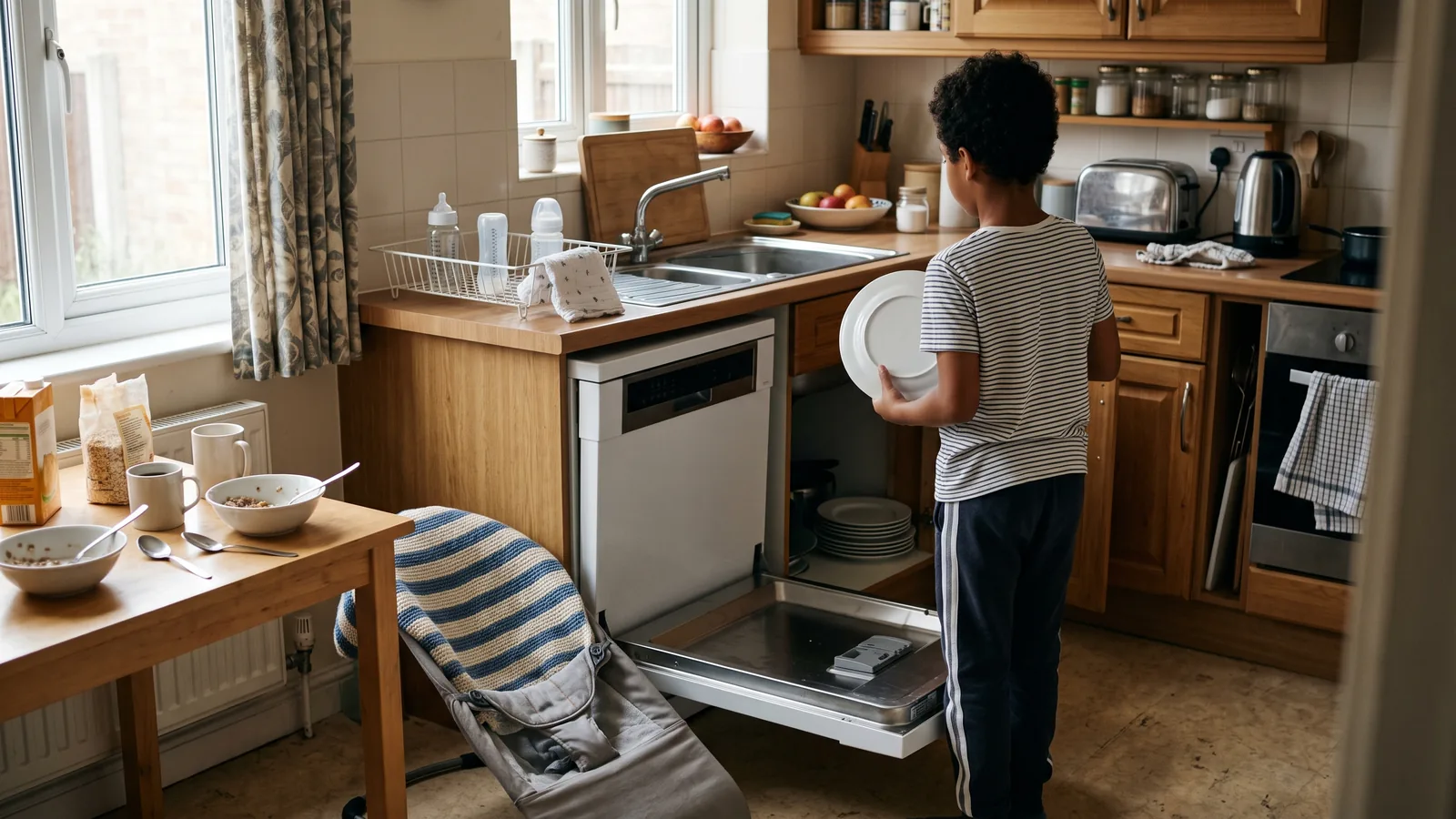
Search for chores and a new baby and most of what comes up is about jealousy: how to introduce the baby, what present the big sibling gets, how to hand them a diaper so they feel useful. It skips the duller question, which is who empties the dishwasher when nobody in the house is sleeping.
We have a one-year-old daughter and three boys, aged 7, 10 and 13, so I have a stake in the answer. Here is what the research says about older kids after a birth, and which chores I would keep and which I would shrink.
When a new baby arrives, shrink the older kids' chore list instead of pausing it. Keep each child's two or three most important jobs, tie them to the same points in the day as before, and make each one easy to check without a parent standing there. Offer baby jobs only to kids who want them, leave the allowance rules alone, and hold off on adding any new chore until the baby is settled.
Should you stop chores when a new baby arrives?
No. Shrink the list, but keep it running. The chore list is part of the routine, and the routine is one of the few things an older child can still count on that month. Nemours KidsHealth tells parents to "keep routines as regular as possible in the days and weeks around the baby's arrival" (KidsHealth). Dropping chores entirely is a big change to that routine, and bringing them back later is a second one.
The American Academy of Pediatrics makes a related point about timing: "Time major changes in your child's routine," meaning finish a change before the baby comes or wait until the baby is settled (AAP, HealthyChildren.org). For chores, that means not handing a child a brand-new job in the month before the due date. A review of 30 studies on becoming a big sibling found that signs of regression may depend on whether a skill is "newly acquired or firmly established" (Volling, Psychological Bulletin, 2012). The newest chore on the list is the one most likely to slip. Expect that, and don't read it as defiance.
Which chores should older kids keep, and which can wait?
Keep the jobs that look after the child's own things and the few that keep the house running. Let the long, skilled jobs shrink for a few weeks. A short list done every day is worth more than a long one nobody has time to check.
Our lists are already split this way. Each kid has about ten items a day, but only a few are real chores, like a bathroom or the trash to the curb. The rest are thirty-second jobs, such as picking clothes up off the bathroom floor, which went on the list because I got tired of being the only one who noticed them. On a normal day the whole list takes under twenty minutes. That split, which I wrote up in how many chores a kid should have each day, is useful here: if I had to cut, the small jobs would stay exactly as they are and the big ones would get cut down to one part. If you are not sure what a child can do alone at their age, start from the list in age-appropriate chores for kids.
| Kind of chore | Examples | With a new baby |
|---|---|---|
| Their own stuff | Making the bed, dirty clothes in the hamper, clearing their own plate | Keep exactly as it was |
| Keeping the house running | Trash and recycling, unloading the dishwasher, feeding the dog | Keep, and give each one a fixed point in the day |
| Big or skilled | A whole bathroom, cooking a meal, deep-cleaning a room | Cut to one part, such as just the sink, for a few weeks |
| Brand new | Anything the child has not yet done on their own | Wait until the baby is settled |
| Baby jobs | Fetching a diaper, picking the baby's outfit, singing at bath time | Offer them, never assign them |
How do you keep chores going when you have no time or sleep?
Set the chores up so they run without you, because for a few months you will not have the time to run them. In a time-diary study of 182 working couples, women's workloads went up by two hours a day after the baby arrived and men's by about 40 minutes (Ohio State University, on a 2015 study in the Journal of Marriage and Family). Sleep goes too. In a study of 4,659 parents, mothers slept about an hour less a night in the first three months after a birth, and fathers about 15 minutes less (University of Warwick, on a 2019 study in Sleep).
A system that depends on a tired parent remembering to ask is the first thing to break. So tie every job to something that happens anyway (after breakfast, before screens, before bed), make the finished job something you can see in passing, and let the consequence arrive without a speech. It is the same setup that holds up when both parents work, which I covered in how to get kids to do chores when you work full time. An app helps only because it does the remembering: each kid sees their own list on their own device, and here is how GrowTide works. A free printable weekly chore chart on the fridge does the same job on paper.
Should older kids help with the new baby?
Let them if they want to, and don't make it a chore if they don't. "Many kids want to help take care of a new baby," KidsHealth says, and the AAP suggests older siblings can help at feeding time or bath time. The same KidsHealth page is just as clear the other way: if a child shows no interest in the baby, "don't be alarmed and don't force it" (KidsHealth).
So baby jobs go on the list as offers, and they sit on top of a child's normal chores rather than replacing them. Otherwise "I'm helping with the baby" becomes a way out of the dishwasher. The help I would push harder for is the kids helping each other. My seven-year-old has a bathroom to clean and can't really clean a bathroom, so an older brother helps and it counts for him too. The older two complained about always being the helper, then invented their own rotation for whose turn it is.
I would not start paying for help with the baby, and I would leave the allowance rules exactly where they were. Helping a sibling is part of being in the family, and paying for it turns it into a job a kid can turn down. If a big paid job shrinks to one part for a few weeks, its pay can shrink with it. How we split paid jobs from unpaid chores is in should allowance be tied to chores.
Is it normal for an older child to regress or refuse chores after a new baby?
Yes, a little, and it usually passes. The AAP tells parents to "expect your child to regress a little" and calls it a child's way of making sure they still have your love and attention (HealthyChildren.org). The research is reassuring. Brenda Volling's review of 30 studies found the evidence "did not support a crisis model," only 3 of its 21 longitudinal studies reported a significant increase in aggression and activity level, and some of the changes "may be short-lived" (Psychological Bulletin, 2012).
So when a chore gets skipped, keep the consequence exactly as it was before the baby: small and the same day, as in what to do when a kid doesn't care about consequences. What helps more is time. KidsHealth suggests setting aside time each day for each older child to get one parent's undivided attention. We already have something like it: a five-minute talk with a parent sits on every kid's list as a daily job. It went on after my wife pointed out that we were not spending real time together. Do I wish a conversation with my own children didn't need to be on a chore list? Yes.
The kid in our house who complains most about his list right now is my seven-year-old. I haven't changed it, and I'm still not sure he's wrong.
Vince is a dad of four and the founder of GrowTide — a family chore and rewards app built by a parent who needed it to actually work. Download GrowTide
This post is one parent's experience, not professional parenting, medical, or psychological advice. Every kid is different, and if what you're dealing with is bigger than a chore system can hold, a family therapist or your pediatrician is a better starting point than a blog.
Frequently asked questions
Should I stop my older child's chores when the new baby comes?
No. Shrink the list instead. Keep the jobs that look after the child's own things and the few that keep the house running, cut big jobs down to one part, and wait to add anything new until the baby is settled. Pediatric guidance is to keep routines as regular as possible.
What chores can an older sibling do to help with a new baby?
Fetching a diaper, picking the baby's outfit, singing or reading at bath time, or helping at feeding time. Offer these on top of the child's normal chores, not in place of them, and don't force a child who isn't interested in the baby.
Is it normal for my older child to regress after a new baby?
Yes, a little. The American Academy of Pediatrics tells parents to expect it, and a review of 30 studies found the changes in older siblings are mixed and some are short-lived. Skills a child learned only recently, including a new chore, are the ones most likely to slip.
How do I keep chores going when I'm sleep-deprived?
Make the chores run without reminders. Tie each job to something that already happens every day, such as before screens or before bed, make the finished job easy to see in passing, and keep the consequence small and automatic so nobody has to argue about it.
Should I pay my older kids to help with the baby?
I wouldn't. Keep the existing allowance rules as they were, and treat help with a sibling as part of being in the family. Paying for it turns it into a job a child can choose to turn down. If a big paid job shrinks for a few weeks, its pay can shrink with it.
Like this? Get the next one in your inbox.
No-fluff parenting tips on chores, allowance, and screen time — from a dad of four. New posts only, no spam.
You're subscribed!
We'll email you whenever a new post goes up.
By subscribing you agree to our Privacy Policy. · Also get the app: Google Play · App Store